
Introduction
Most mobile app projects fail before they ship. Not because of bad code, but because teams build too much, too soon, without knowing if anyone wants it.
About 34% of startup failures trace back to “no market need.” Founders build features they think are great. Users disagree. By then, the budget is gone.
That’s the core tension behind the MVP vs. full build debate. And it’s a decision that can make or break your product.
This guide helps you decide between MVP and full build.
What Is an MVP?
An MVP (Minimum Viable Product) is the simplest version of your app that actually works.
It includes only the core features needed to solve one problem. Nothing extra. The goal is to launch fast, get real user feedback, and learn before you spend big.
Dropbox validated their idea with just a 3-minute explainer video before writing a single line of code. Their waiting list grew from 5,000 to 75,000 users overnight.
That is the power of an MVP done right.
An MVP is not a half-baked product. It is a strategic decision to learn before you commit.
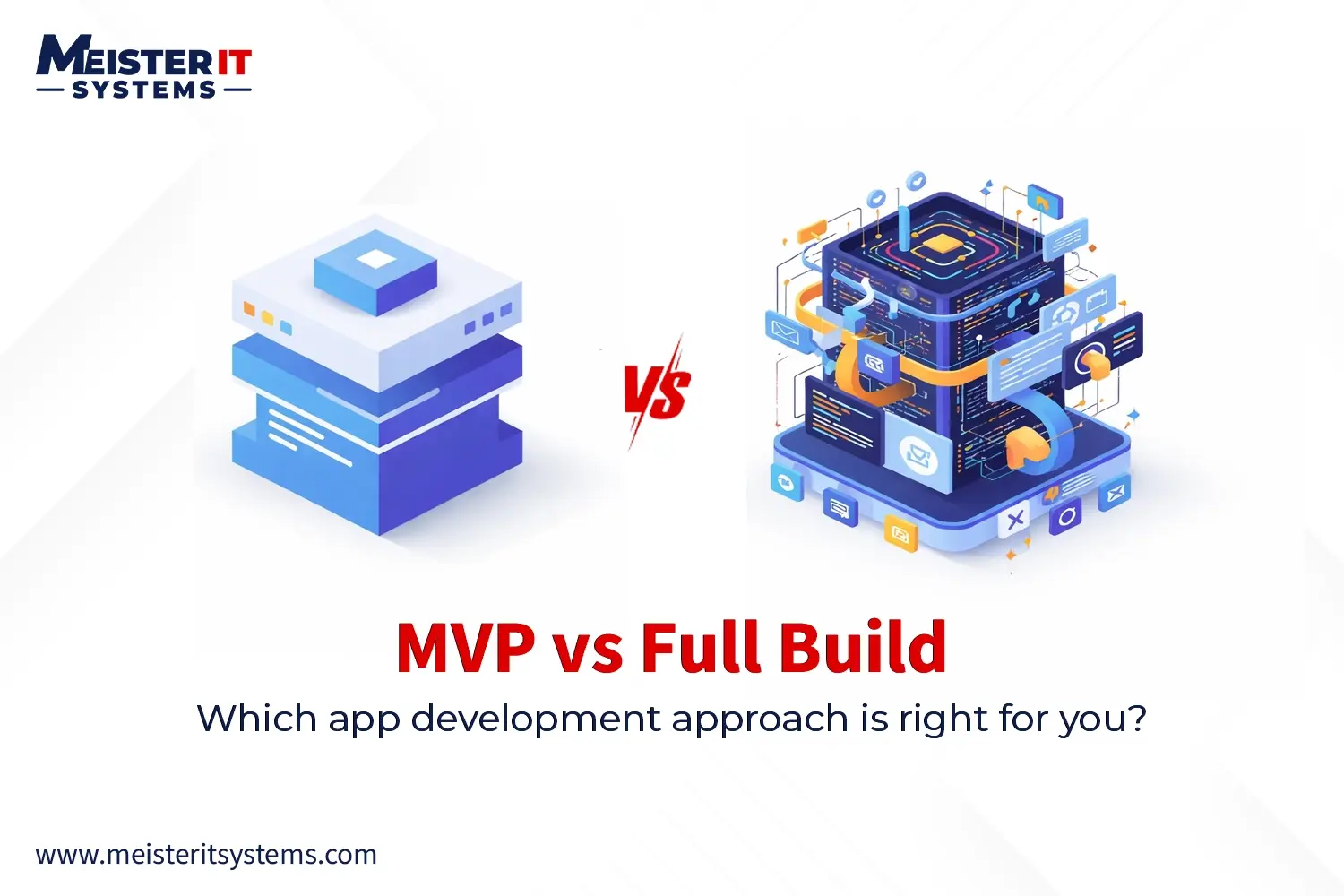
MVP vs. Full Build: The Key Differences
Here are the key differences between an MVP and a fully developed app.
| Aspect | MVP | Full Build |
|---|---|---|
| Timeline | 8 to 12 weeks | 6 to 12+ months |
| Cost | $15K to $80K | $80K to $400K+ |
| Risk | Lower | Higher |
| Goal | Validate the idea | Launch a complete product |
| Best for | New ideas, early-stage | Proven markets, enterprise |
When Should You Build an MVP?
Before building an MVP, keep these things in mind.
1. You Are Testing a New Idea
If your product concept has not been validated with real users, build an MVP first. You need evidence before you invest heavily.
An MVP typically takes 8 to 12 weeks, depending on complexity. The focus is on getting to market fast so you can validate your assumptions early.
2. You Have a Limited Budget or Tight Timeline
An MVP keeps your investment focused on what matters most. You avoid spending money on features users never asked for.
3. You Are Raising Funding
Investors want proof. A working MVP with real user data is more compelling than a pitch deck with mockups.
4. You Want to Learn Before You Scale
Startups using MVP approaches have a 60% higher success rate than those launching fully-featured products.
That gap exists because MVPs force honest learning. You find out fast what works and what does not.
When Should You Go Straight to a Full Build?
Before committing to a full build, make sure these conditions actually apply to you.
1. Your Idea Is Already Proven
If you have done the validation work and you know there is demand, a full build makes sense. You are not guessing anymore.
2. You Are in a Regulated Industry
Healthcare, finance, and legal apps often cannot launch with a stripped-down product. Compliance requirements demand a complete solution from the start.
Healthcare providers building patient management apps need a complete, compliant solution in place before any public or internal release.
3. You Are an Established Brand Replacing a Core System
If you are replacing a system that your business depends on daily, an MVP may not cut it. Users expect a complete experience.
4. You Have the Budget and a Clear Scope
Full builds work well when you already know exactly what to build. Uncertainty is expensive at full scale.
The Most Common Mistake Teams Make
Below are the 5 most common mistakes teams make:
- MVP vs. full build is not a permanent decision. It is just where you start.
- Your MVP will evolve. What feels “minimum” today will change as real users give you real feedback.
- Uber, Airbnb, and Dropbox all started with an MVP. They learned fast and built bigger once they knew it worked.
- Most teams that fail try to build everything up front. They spend months building features nobody asked for.
- Start small, learn quickly, and let the data tell you what to build next.
How to Decide: 5 Questions to Ask Yourself
Before you pick an approach, run through these five questions honestly.
1. Has this idea been validated with real users?
If no, start with an MVP.
2. Do we have a clear, stable feature scope?
If no, an MVP will save you from building the wrong thing.
3. Are there regulatory or compliance requirements from day one?
If yes, you likely need a full build.
4. Is this product central to the business from launch?
If yes, a full build may be justified.
5. What does our runway look like?
If the budget is limited, an MVP protects you from overbuilding.
Conclusion
There is no one-size-fits-all answer. If your idea is unproven, start with an MVP. If the scope is clear and the demand is validated, go full build. The goal is not to build fast. The goal is to build the right thing at the right time.
Need help choosing the right approach for your app?
At Meisterit Systems, we help CTOs and product teams make this decision every day. Whether you need a lean MVP to validate fast or a full build to scale with confidence, we help you build smarter from day one.
FAQ: MVP vs. Full Build
Q1: What does MVP stand for in app development?
A1: MVP stands for Minimum Viable Product. It is the simplest working version of an app that solves a core problem and helps teams validate their idea with real users before committing to a full build.
Q2:How long does it take to build an MVP?
A2: Most MVPs take 8 to 12 weeks to build, depending on complexity. Some simpler products can launch in as little as 4 to 6 weeks with the right team.
Q3: Is an MVP cheaper than a full app?
A3: Yes. MVP development typically costs between $15,000 and $80,000. A full-scale app can range from $80,000 to over $400,000 depending on features and complexity.
Q4: Can an MVP become a full product?
A4: Absolutely. Most successful apps started as MVPs. Once you validate the idea and understand what users need, you build out the full product based on real evidence rather than assumptions.
Q5: What is the risk of skipping an MVP?
A5: You risk building a product nobody wants. Without validation, you can spend six to twelve months and a significant budget on something that misses the mark entirely.