
Key Takeaways
- RAG connects LLMs with real-time business data to improve accuracy.
- It reduces hallucinations by grounding responses in verified enterprise knowledge.
- RAG is useful for customer support, enterprise search, internal knowledge assistants, and compliance.
- A production-ready RAG system needs strong data processing, retrieval, security, and monitoring.
- MeisterIT Systems builds secure, scalable RAG applications and enterprise AI solutions.
Introduction
As organizations increasingly adopt AI-powered applications, a common challenge quickly emerges: Large Language Models (LLMs) can generate impressive responses, but they often lack access to current business information. This can lead to inaccurate answers, outdated knowledge, and AI hallucinations, making it difficult to use AI reliably in enterprise environments.
Retrieval-Augmented Generation addresses this challenge by combining the reasoning capabilities of LLMs with real-time access to enterprise data sources such as databases, CRM platforms, ERP systems, documents, and knowledge bases.
In this guide, we’ll explore how RAG works, how to integrate it into your application, and the costs involved in building a production-ready solution.
What is RAG?
Retrieval-Augmented Generation is an AI architecture that enhances Large Language Models by connecting them to external knowledge sources.
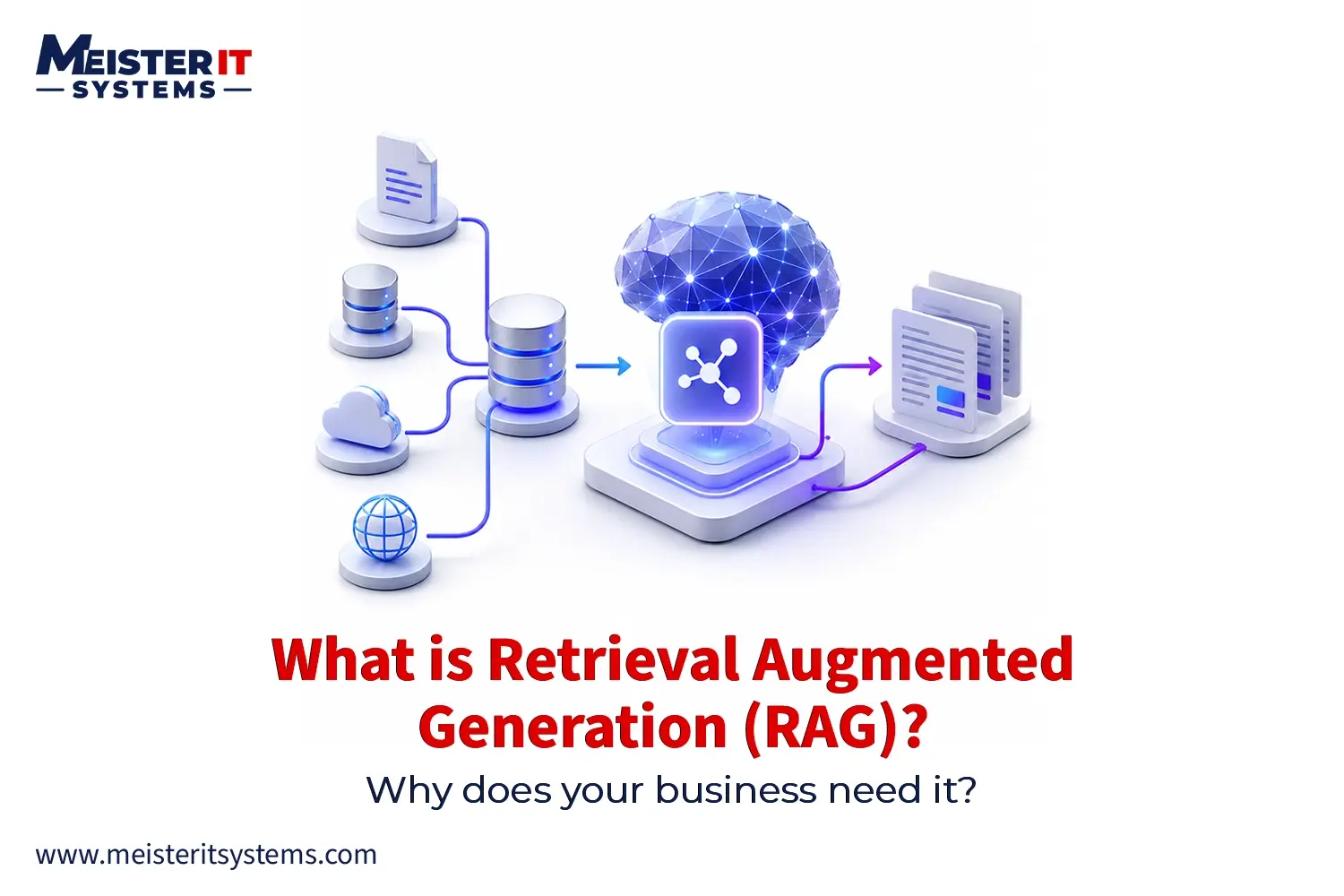
Instead of generating responses only from training data, a RAG system first retrieves relevant information from documents, databases, knowledge bases, or business systems. Then it uses that information to generate a more accurate response.
Think of it as giving your AI application access to your organization’s knowledge in real time.
“What is our current travel reimbursement policy?”
A traditional LLM may provide a generic answer based on publicly available information.
A RAG-powered application will search your company’s policy documents, retrieve the latest version of the reimbursement policy, and generate a response based on that specific document. As a result, users receive accurate, up-to-date, and context-aware answers.
What Problems Does RAG Solve?
The rapid adoption of generative AI has exposed several challenges that limit the effectiveness of standalone LLMs. RAG addresses many of these issues.
1. AI Hallucinations
One of the biggest concerns with LLMs is hallucination, where the model generates information that sounds convincing but is incorrect.
By grounding responses in verified enterprise data, RAG significantly reduces hallucinations and improves trustworthiness.
2. Outdated Knowledge
Business information changes constantly.
Product documentation gets updated, policies evolve, customer information changes, and new knowledge is created every day.
Without RAG, organizations would need to retrain models frequently to keep information current. RAG eliminates this challenge by retrieving the latest information directly from connected data sources.
3. Knowledge Silos
Enterprise knowledge is often scattered across:
- ERP systems
- CRM platforms
- Internal databases
- SharePoint repositories
- PDFs and documents
- Support tickets
- Email archives
RAG creates a unified intelligence layer that makes this information searchable through natural language.
4. High Fine-Tuning Costs
Fine-tuning a model every time business information changes can become expensive and difficult to maintain.
RAG offers a more practical alternative by separating knowledge retrieval from language generation.
Common Enterprise Use Cases for RAG
Organizations are using RAG across multiple business functions to improve knowledge accessibility and automate information retrieval.
1.Customer Support
Support teams can instantly access product documentation, troubleshooting guides, and policy information to provide faster and more accurate responses.
2.Internal Knowledge Assistants
Employees can ask questions about HR policies, travel guidelines, onboarding processes, and company procedures using natural language.
3.Enterprise Search
Instead of manually searching across multiple systems, employees can retrieve information from documents, databases, and knowledge repositories through a single AI-powered interface.
4.Sales Enablement
Sales teams can quickly access pricing information, product specifications, contract details, and competitive intelligence during customer interactions.
5.Compliance and Policy Management
Organizations can provide employees with accurate responses based on the latest regulatory documents and internal compliance guidelines.
RAG vs Fine-Tuning: Which Approach is Better?
Many organizations evaluating AI solutions often compare RAG and fine-tuning.
| RAG | Fine-Tuning |
|---|---|
| Uses external knowledge sources | Modifies model behavior |
| Easy to update information | Requires retraining |
| Lower maintenance effort | Higher maintenance effort |
| Better for enterprise knowledge management | Better for specialized tasks |
| Faster implementation | Longer implementation cycle |
For most enterprise applications involving documents, policies, knowledge bases, and business information, RAG is typically the preferred approach.
Fine-tuning is usually reserved for situations where the model must learn a specific behavior, tone, or domain expertise.
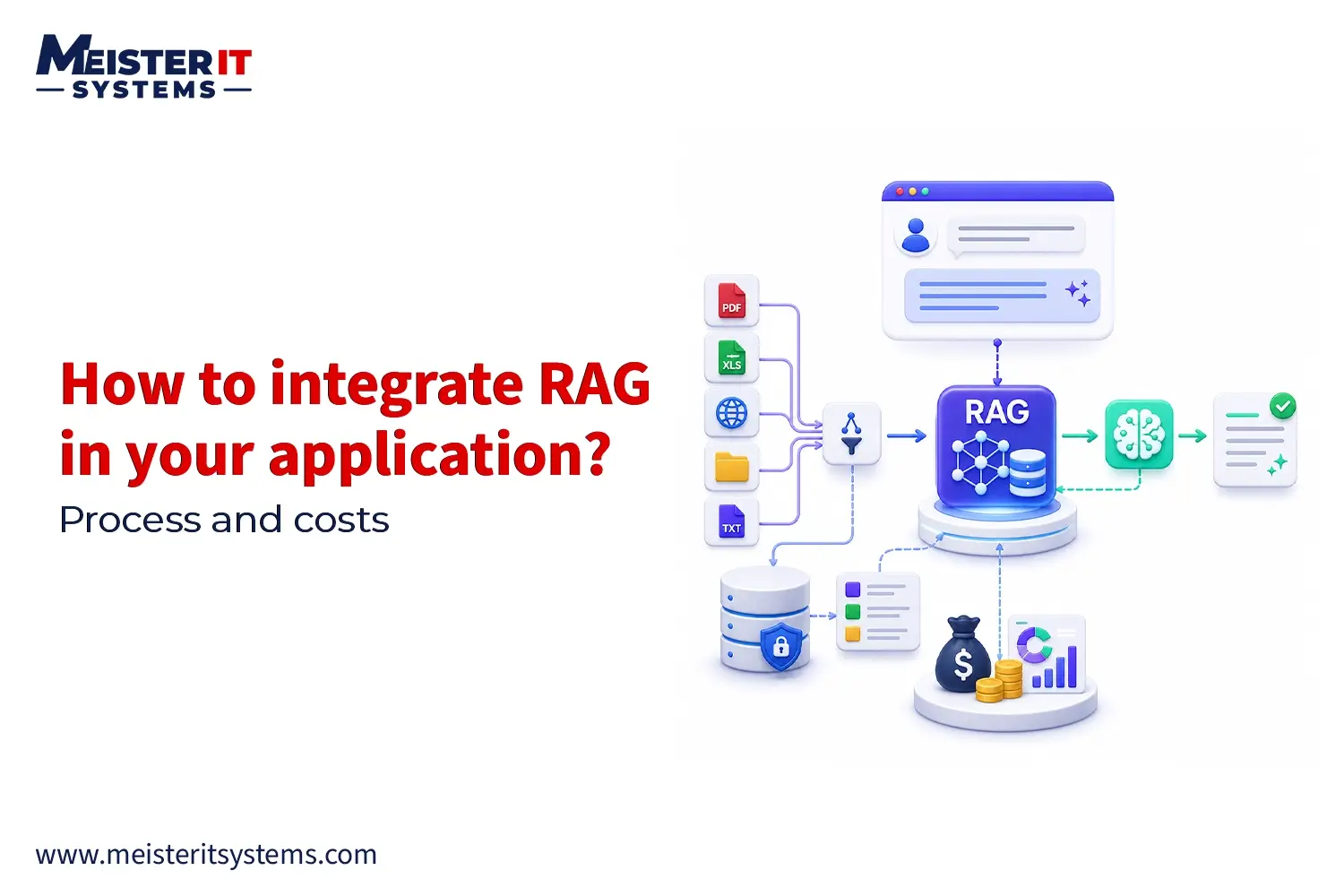
How Does RAG Work?
Before implementing RAG, it’s important to understand the workflow behind the architecture.
Step 1: Data Collection
The process begins by collecting enterprise knowledge from various sources, such as:
- ERP systems
- CRM platforms
- Databases
- Internal documents
- Product manuals
- Wikis and knowledge bases
Step 2: Data Processing and Chunking
Large documents are divided into smaller sections called chunks.
Instead of searching an entire 100-page document, the system can retrieve only the relevant paragraphs needed to answer a question.
Step 3: Embedding Generation
Each chunk is converted into a vector embedding.
Embeddings transform text into numerical representations that capture semantic meaning rather than simple keyword matching.
This allows the system to understand context and intent.
Step 4: Vector Database Storage
The embeddings are stored inside a vector database.
This database enables fast semantic search across millions of documents.
Step 5: User Query
When a user asks a question, the query is also converted into an embedding.
Step 6: Information Retrieval
The system compares the query embedding with stored embeddings and retrieves the most relevant content.
Step 7: Response Generation
The retrieved information is passed to the LLM as context.
The model then generates a response grounded in the retrieved data, improving accuracy and reliability.
RAG Architecture Explained
A production-ready RAG system consists of several interconnected layers.
1.Data Layer
This layer contains all enterprise knowledge sources, including structured and unstructured data.
Examples include:
- Salesforce records
- SAP data
- Knowledge bases
- Internal documentation
- Customer support tickets
2.Data Processing Layer
The processing layer handles:
- Data ingestion
- Cleaning
- Formatting
- Chunking
- Metadata enrichment
Data quality at this stage directly impacts AI performance.
3.Embedding Layer
Embedding models convert text into vectors that capture semantic meaning.
This enables context-aware search instead of simple keyword matching.
4.Vector Database Layer
Popular vector databases include:
- Pinecone
- Weaviate
- Milvus
- Qdrant
The database stores embeddings and enables high-speed similarity searches.
5.Retrieval Layer
The retrieval engine identifies and ranks the most relevant information based on the user’s query.
Advanced retrieval systems may use:
- Semantic search
- Hybrid search
- Metadata filtering
- Reranking models
6.LLM Layer
The retrieved information is provided to an LLM such as GPT, Claude, Gemini, or Llama.
The model uses this context to generate the final response.
7.Application Layer
This is the user-facing component where users interact with the AI through:
- Web applications
- Mobile applications
- Chatbots
- Internal portals
- Enterprise search systems
Step-by-Step Process to Integrate RAG into Your Application
Implementing a Retrieval-Augmented Generation (RAG) solution involves much more than connecting a Large Language Model to a vector database. A successful deployment requires careful planning around data architecture, retrieval strategies, security, scalability, and ongoing optimization.
Below is a practical step-by-step approach that technical teams can follow when building a production-ready RAG application.
Step 1: Define the Business Use Case
Every successful RAG implementation starts with a clear objective. Before choosing tools or models, identify the problem you want AI to solve.
For example, organizations commonly use RAG for customer support automation, enterprise search, internal knowledge assistants, policy management, and document intelligence.
At this stage, determine:
- Who will use the application?
- What types of questions should it answer?
- Which systems contain the required information?
- What level of accuracy and security is required?
A clearly defined use case helps shape the architecture and ensures the solution delivers measurable business value.
Step 2: Connect and Prepare Enterprise Data
Once the use case is established, the next step is identifying and connecting the systems where organizational knowledge resides.
This may include ERP platforms, CRM systems, databases, internal wikis, SharePoint repositories, PDFs, product manuals, and knowledge bases.
The collected data is then cleaned, standardized, and organized to eliminate duplicates, outdated information, and inconsistencies. Since retrieval quality depends entirely on data quality, this stage lays the foundation for the entire RAG system.
Step 3: Process Documents and Create Embeddings
Raw documents cannot be searched semantically by AI models. They first need to be processed into a machine-understandable format.
Large documents are divided into smaller chunks, preserving context while making retrieval more efficient. These chunks are then converted into vector embeddings using embedding models.
Unlike traditional keyword indexing, embeddings capture the meaning and relationships between concepts, allowing the system to retrieve information based on context rather than exact word matches.
Step 4: Store Knowledge in a Vector Database
The generated embeddings are stored in a vector database such as Pinecone, Weaviate, Milvus, Qdrant, or Chroma.
This database serves as the knowledge retrieval layer of the RAG architecture.
When users submit queries, the vector database quickly identifies the most relevant content by comparing semantic similarity between the query and stored embeddings.
Without this layer, the system cannot efficiently search large volumes of enterprise information.
Step 5: Build the Retrieval Layer
The retrieval layer acts as the bridge between enterprise knowledge and the LLM.
When a user asks a question, the system converts the query into an embedding and searches the vector database for relevant information. The most relevant results are then filtered, ranked, and prepared as context.
Advanced implementations often combine semantic search, keyword search, metadata filtering, and reranking models to improve retrieval accuracy.
The quality of retrieval directly influences the quality of AI-generated responses.
Step 6: Integrate the Large Language Model (LLM)
After relevant information is retrieved, it is sent to a Large Language Model such as OpenAI GPT, Anthropic Claude, Google Gemini, or open-source models like Meta Llama.
The LLM uses the retrieved content as context when generating a response.
Instead of relying solely on its training data, the model answers using current, business-specific information, significantly improving accuracy and reducing hallucinations.
Step 7: Implement Security and Access Controls
Enterprise RAG systems often work with sensitive business information, making security a critical requirement.
Organizations typically implement role-based access controls, authentication systems, data encryption, audit logging, and compliance policies to ensure users can only access information they are authorized to view.
Security should be incorporated into the architecture from the beginning rather than added after deployment.
Step 8: Test, Optimize, and Deploy
Before going live, the system should be evaluated for retrieval accuracy, response quality, latency, and reliability.
Testing helps identify gaps in data quality, retrieval performance, and prompt design before users interact with the system.
Once validated, the application can be deployed and continuously monitored to improve performance, expand data sources, and scale as adoption grows.
Technology Stack for RAG Development
A typical RAG implementation includes multiple components working together.
| Layer | Technology Options |
|---|---|
| Data Sources | ERP, CRM, Documents, Databases |
| Data Processing | ETL Pipelines, Python Workflows |
| Embeddings | OpenAI Embeddings, BGE, E5 |
| Vector Database | Pinecone, Weaviate, Milvus, Qdrant |
| LLM | GPT, Claude, Gemini, Llama |
| Application Layer | Web Apps, APIs, Mobile Apps |
| Monitoring | Logging and Analytics Platforms |
The ideal stack depends on scalability, compliance requirements, and business objectives.
How Much Does RAG Integration Cost?
The cost of implementing RAG varies depending on data volume, complexity, infrastructure requirements, and usage levels.
- One-Time Development Costs: $10,000 to $100,000+
- Infrastructure Costs: $100 to $2,000+ per month
- LLM Usage Costs: $100 to $5,000+ per month
- Vector Database Costs: $50 to $1,000+ per month
- Maintenance Costs: Depends on data updates, monitoring, optimization, and infrastructure management.
Common Challenges During RAG Implementation
Organizations frequently encounter:
- Poor data quality
- Inaccurate chunking strategies
- Weak retrieval performance
- Security concerns
- Scalability issues
- Cost optimization challenges
Most of these issues can be mitigated through proper architecture design and governance.
Best Practices for Enterprise RAG Deployments
To maximize ROI and long-term success:
- Start with a high-value use case
- Prioritize data quality
- Use metadata filtering wherever possible
- Continuously evaluate retrieval accuracy
- Monitor hallucination rates
- Implement robust security controls
- Scale gradually based on measurable business outcomes
Organizations that treat RAG as a strategic capability rather than a standalone AI feature often achieve the best results.
How MeisterIT Systems Can Help
Building an enterprise-grade RAG application requires expertise across AI engineering, cloud infrastructure, data architecture, and application development.
At MeisterIT Systems, we help organizations design, develop, and deploy scalable RAG solutions tailored to their business requirements. From integrating enterprise data sources and implementing vector databases to deploying secure AI applications powered by advanced LLMs, our team provides end-to-end support throughout the AI adoption journey.
Whether you’re developing an internal knowledge assistant, customer support solution, or enterprise search platform, we help transform your existing business knowledge into intelligent, actionable insights.
Conclusion
Retrieval-Augmented Generation has become one of the most effective approaches for building enterprise AI applications. By combining the reasoning capabilities of Large Language Models with real-time access to business knowledge, organizations can deliver more accurate, reliable, and context-aware AI experiences.
While successful implementation requires careful planning around architecture, data quality, security, and cost management, the benefits can be significant. Businesses that adopt RAG strategically can improve productivity, reduce information silos, enhance customer experiences, and unlock greater value from their existing knowledge assets.
As AI adoption continues to accelerate, RAG is emerging as a foundational technology for organizations seeking to build intelligent applications that are both trustworthy and scalable.
Looking to implement RAG in your organization?
Contact us for expert guidance on AI integration, enterprise data connectivity, and scalable RAG solutions.
Frequently Asked Questions
Q1: What is the difference between RAG and fine-tuning?
A1: RAG (Retrieval-Augmented Generation) retrieves information from external knowledge sources in real time before generating a response. Fine-tuning, on the other hand, retrains a model to learn specific behaviors, tasks, or domain expertise. For enterprise knowledge management, RAG is often more flexible and cost-effective because information can be updated without retraining the model.
Q2: Do I need a vector database to implement RAG?
A2: Most production-ready RAG systems use a vector database to store embeddings and enable semantic search. Popular options include Pinecone, Weaviate, Qdrant, Milvus, and Chroma. While simpler implementations can use traditional search methods, vector databases significantly improve retrieval accuracy and scalability.
Q3: Can RAG integrate with ERP, CRM, and legacy systems?
A3: Yes. RAG can connect with enterprise systems such as SAP, Oracle, Salesforce, Microsoft Dynamics, internal databases, SharePoint repositories, document management systems, and other business applications. This allows AI applications to access organization-specific knowledge in real time.
Q4: How much does it cost to build a RAG application?
A4: The cost depends on factors such as data volume, infrastructure requirements, vector database selection, LLM usage, and integration complexity. Small-scale implementations may cost a few thousand dollars, while enterprise-grade deployments with advanced security and large datasets can require significantly higher investments.
Q5: How does RAG reduce AI hallucinations?
A5: RAG improves response accuracy by retrieving relevant information from trusted data sources before generating an answer. Since responses are grounded in actual business data rather than relying solely on the model’s training knowledge, the likelihood of hallucinations is significantly reduced.
Q6: How long does it take to implement a RAG solution?
A6: Implementation timelines vary based on project complexity. A basic proof of concept can often be developed within a few weeks, while enterprise-scale deployments involving multiple data sources, security controls, and custom workflows may take several months to fully implement and optimize.