
Introduction
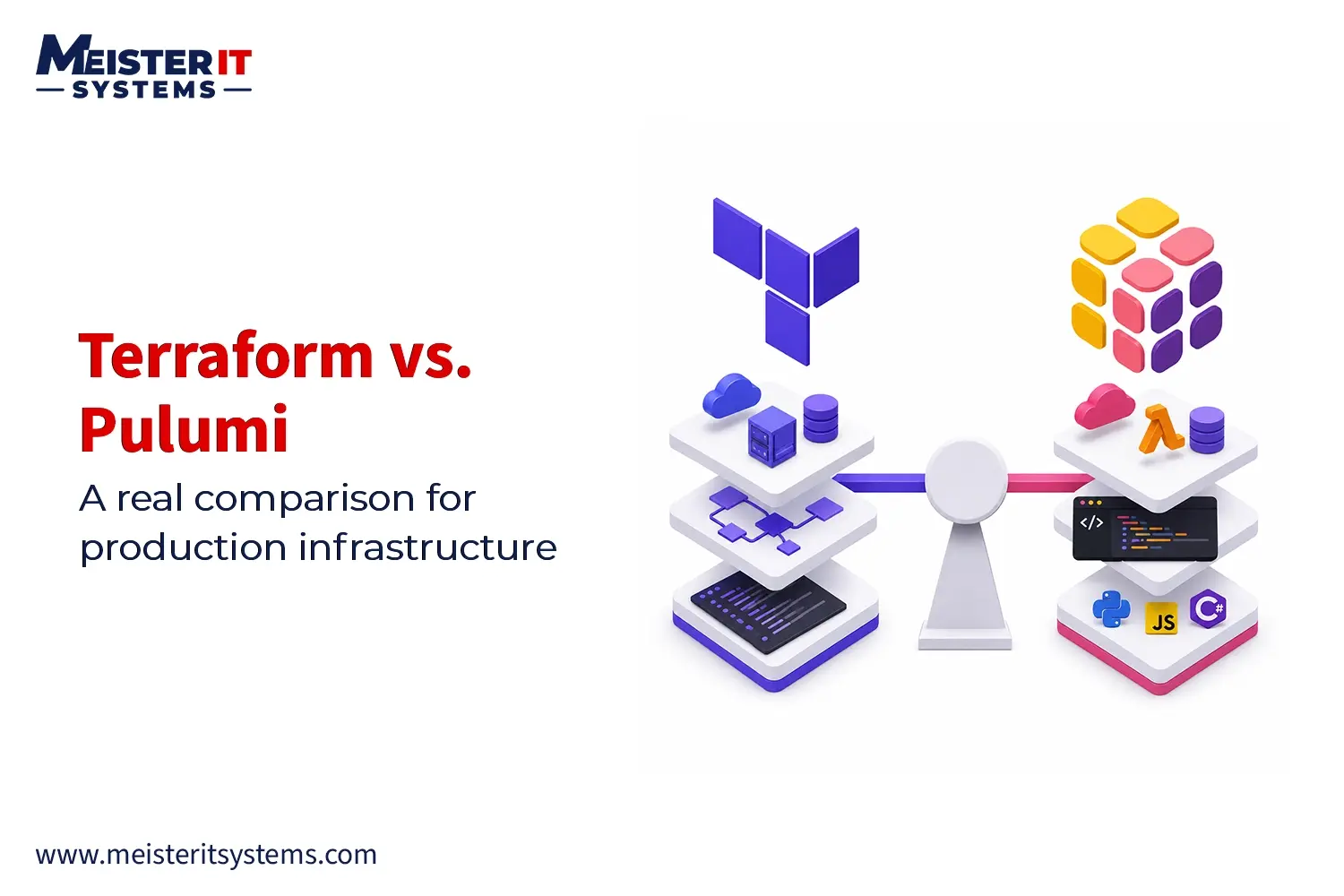
Choosing between Terraform and Pulumi is not a small call. It affects how your team deploys, debugs, and scales infrastructure for years. At MeisterIT Systems, we have helped engineering teams navigate this exact decision across production environments of all sizes. The real question is not which tool is more popular.
Which one will your team actually maintain well under pressure? This article breaks down the honest differences so you can make the right call for your stack.
What is Terraform?
Terraform, built by HashiCorp, uses a declarative model written in HCL (HashiCorp Configuration Language). You define the end state of your infrastructure, and Terraform calculates what needs to change to get there. It is the most widely used IaC tool in production environments today.
Here is what makes Terraform work in production:
- Declarative HCL syntax that is readable and auditable without needing programming experience
- Execution plans via terraform plan that show exactly what will change before anything is applied
- State file management that tracks all resources and detects drift from the desired configuration
- Massive provider ecosystem covering AWS, Azure, GCP, Cloudflare, Datadog, and hundreds more
- Module system that allows teams to build reusable infrastructure components
- Workspace support for managing multiple environments from a single codebase
Terraform’s strength is its predictability. The plan output makes it easy to review changes in pull requests, and the breadth of its provider support means you rarely hit a wall when integrating third-party services.
What is Pulumi?
Pulumi takes a different route. Instead of a custom DSL, it lets you write infrastructure in real programming languages, including TypeScript, Python, Go, C#, and Java. The model is imperative, meaning you write code that describes how to build your infrastructure using full language constructs.
Here is what sets Pulumi apart:
- General-purpose language support so your infrastructure code works like any other software project
- Native loops, conditionals, and functions without workarounds or DSL limitations
- Stack-based state management stored in Pulumi Cloud or your own backend, like S3 or Azure Blob
- Built-in secrets encryption in state, so sensitive values are not stored in plaintext
- Unit testing support using frameworks your developers already know
- Tighter developer workflow integration with the same linting, IDE tooling, and PR process as application code
Pulumi is a strong choice when your infrastructure has dynamic, programmatic requirements that HCL cannot express cleanly. The tradeoff is that it demands stronger engineering discipline to stay maintainable at scale.
Terraform vs Pulumi: Core Differences That Matter in Production
This comparison focuses on real production trade-offs. Not features on paper, but how each tool behaves under scale, team pressure, and ongoing infrastructure changes.
| Area | Terraform | Pulumi |
|---|---|---|
| Model | Declarative (desired state) | Imperative (how to build) |
| State & Drift | Clear, predictable plan output | Preview works but harder at scale |
| Reusability | Modules (can get verbose) | Native language packages |
| Learning Curve | Faster for ops teams | Slower, needs dev expertise |
| Languages | HCL (DSL) | TypeScript, Python, Go, etc. |
| Complexity Ceiling | Limited with dynamic infra | Much higher flexibility |
| Testing | Limited, external tools | Native testing support |
| Ecosystem | Mature, wide provider support | Growing but smaller |
Choose based on team strength and system complexity. Terraform optimizes for control and clarity. Pulumi unlocks flexibility but only pays off with strong engineering discipline.
Performance and Scalability: How Each Tool Handles Large Infrastructure
Here is how Terraform and Pulumi behave when infrastructure scales beyond simple deployments. This is where execution models, state handling, and architectural decisions start impacting performance and operability.
- Scale exposes trade-offs: Both handle mid-size infra well. At scale, Terraform slows with large state files; Pulumi gets complex with deep code logic.
- Where complexity sits: Terraform → state management. Pulumi → code design. Neither scales cleanly without upfront structure.
- Execution & parallelism: Terraform uses configurable parallelism. Pulumi uses dependency graphs. Real bottleneck is cloud API limits, not the tool.
- Multi-cloud reality: Both support AWS, Azure, GCP. Tooling helps, but IAM, networking, and cross-cloud differences still need manual handling.
Security and Compliance: Where Terraform and Pulumi Differ
The table below breaks down how Terraform and Pulumi handle security and compliance in real environments. These differences directly impact how you manage secrets, enforce policy, and pass audits at scale.
| Area | Terraform | Pulumi |
|---|---|---|
| Secrets Management | Plaintext in state by default; needs Vault or encrypted backends | Native encryption using KMS, Key Vault, etc. |
| Policy as Code | Sentinel / OPA (mature, widely adopted) | CrossGuard (code-first, growing adoption) |
| Auditability & Governance | Strong plan output, integrates with PR workflows, and Terraform Cloud | Pulumi Cloud with audit logs, stack history, and dashboard |
| Enterprise Readiness | More battle-tested in regulated environments | Improving, but less proven at enterprise scale |
CI/CD Integration: Comparing Pipeline Workflows for Terraform and Pulumi
How your pipelines run day-to-day depends heavily on the tool and how much workflow you want predefined versus code-driven.
- Pipeline flow: Both follow PR → preview/plan → merge → apply/up. Terraform is standardized and familiar; Pulumi integrates cleanly with modern CI tools and code-based workflows.
- Ecosystem: Terraform uses Atlantis and Terraform Cloud. Pulumi has native GitHub Actions and built-in integrations.
- Environments: Terraform uses workspaces; Pulumi uses stacks. Both work, both need discipline to avoid drift.
Team Structure and Workflow: How Each Tool Affects Ownership
Tool choice directly affects ownership, collaboration, and how teams interact with infrastructure.
- Ownership model: Terraform fits DevOps-led teams. Pulumi enables developer-owned infrastructure.
- Code reviews:Terraform is predictable and readable. Pulumi depends on code quality and abstractions.
- Debugging: Terraform is simpler with clear plans and logs. Pulumi requires debugging both infra and code execution.
Cost Considerations: Open Source, Managed Services, and Long-Term Overhead
IaC tools are not free once you factor in managed services and operational effort. Both tools have open-source CLIs at no cost, but the real expenses appear at the managed layer and in the long-term maintenance burden your team carries forward.
1. Open Source vs Managed Offerings
Both CLIs are free. Terraform Cloud charges for policies, SSO, and audit logging on paid plans. Pulumi Cloud is free for up to 200 resources, with paid tiers for more. At a significant scale, both tools incur real SaaS costs that should be built into your infrastructure budget from the start.
2. Operational Overhead
Self-hosting Terraform means managing S3 state, DynamoDB locking, and Atlantis for PR automation. That is manageable, but adds ongoing operational load. Pulumi Cloud offloads all of that and includes a built-in dashboard. For teams wanting less infrastructure-around-the-infrastructure, Pulumi Cloud has a slight operational advantage worth considering.
3. Long-Term Maintenance Cost
Terraform’s HCL changes slowly and stays readable years later with minimal upkeep. Pulumi codebases need ongoing maintenance: dependency upgrades, language version management, and refactoring as abstractions evolve. Strong engineering discipline makes Pulumi manageable long-term. Without it, Terraform’s simpler model is the safer bet.
When to Choose Terraform vs Pulumi for Production
Picking the right tool comes down to matching your current reality, not the ideal scenario on paper. Here is a clear breakdown of when each tool genuinely makes more sense based on what engineering teams actually deal with in production.
When Terraform is the Right Choice
- Your team is DevOps-focused and comfortable with HCL
- You need the broadest provider coverage available right now
- You are in a regulated industry where mature governance tooling matters
- Your infrastructure is relatively stable and well-defined
- You want predictable, auditable changes with minimal code complexity
When Pulumi is the Right Choice
- Your infrastructure has dynamic requirements that HCL cannot express cleanly
- Developers own their own infrastructure and are comfortable in TypeScript or Python
- Secrets management is a priority without bolting on additional tooling
- You are building internal platforms that need real programming abstractions
- Your team already writes tests for infrastructure and wants to continue that practice
Hybrid Approaches in Production
Some teams run both tools together. Terraform handles stable foundational infrastructure. Pulumi handles dynamic application-layer resources. This works only when ownership boundaries are clear and separate teams manage each tool.
Overlapping use creates state confusion and accountability gaps. Treat it as a deliberate decision, not a compromise.
5 Common Pitfalls and How to Avoid Them
Both Terraform and Pulumi come with real failure modes in production. Here are the five that teams hit most often and what to do about each one before it causes an incident.
Pitfall 1: State File Mismanagement
Problem: Teams store state locally or in unprotected remote storage. One corrupted or lost state file disconnects Terraform from your entire production environment with no clean recovery path.
Solution: Use remote state with locking from day one. S3 with DynamoDB locking is the standard AWS pattern. Restrict backend access with IAM policies. Never manually edit the state file without knowing exactly what you are changing and why.
Pitfall 2: Overengineering Infrastructure Code
Problem: Pulumi teams build elaborate class hierarchies and heavy abstractions before requirements are clear. The code becomes harder to debug than the infrastructure it is supposed to manage.
Solution: Start simple. Build abstractions only when you have genuine repetition that needs to stay in sync across environments. Readable infrastructure code is always more valuable than clever infrastructure code.
Pitfall 3: No Governance Controls
Problem: Without policy enforcement, both tools drift toward unreviewed changes and one-off manual fixes in the cloud console. You lose visibility into what changed, when it changed, and who changed it.
Solution: Require plan output in PRs. Block applies without approval. Enforce tagging policies. Audit resource creation in cloud accounts independently of your IaC tool. Governance is a process, not a feature of the tool itself.
Pitfall 4: Ignoring Drift Until It Breaks Something
Problem: Teams skip running the plan or preview before applying changes. A manual console change made weeks ago silently conflicts with a new deployment and causes an unexpected production incident.
Solution: Run plan or preview before every apply, not just in CI. Build drift detection into your monitoring workflow. Treat any manual change to production infrastructure as a process violation worth reviewing and correcting immediately.
Pitfall 5: Migrating Tools Without a Rollback Plan
Problem: Teams switch IaC tools mid-project and underestimate the state migration risk. Resources get recreated when they should be imported. Production breaks during the migration window with no clean path back.
Solution: Never migrate a production environment without a tested rollback plan. Use pulumi import or terraform import to bring existing resources under the new tool first. Validate thoroughly in a non-production environment before touching anything live.
Switching IaC tools mid-flight is high risk and should only be done with a clear, tested plan.
- When it makes sense: Best for new projects or planned rewrites. Avoid mid-production migrations unless you’ve hit a hard limitation.
- Key risks: State mismatch, unintended resource recreation, and team knowledge gaps.
Fix the architecture in your current tool first. Migrate only when the limitations are proven and unavoidable.
Step-by-Step Migration Considerations
Both migration routes require importing existing resources before decommissioning anything, and testing thoroughly in a non-production environment first. Skipping either step is how migrations turn into production incidents.
From Terraform to Pulumi:
- Use Pulumi’s tf2pulumi tool to generate a starting point from your HCL
- Review generated code carefully since it is not production-ready out of the box
- Import existing resources into Pulumi state using pulumi import
- Validate that no resource recreation is triggered before applying to production
- Test in a non-production environment first, then migrate one stack at a time
From Pulumi to Terraform
- Write equivalent Terraform configurations manually from your existing resource inventory
- Use terraform import to bring resources under Terraform management
- Plan for a maintenance window or blue/green approach for critical systems
- Validate state consistency before decommissioning any Pulumi stacks
How MeisterIT Systems Can Help You Choose and Implement the Right IaC Tool?
At MeisterIT Systems, we help engineering teams make this decision based on what their infrastructure actually requires. We assess your current stack, team structure, and growth plan, then recommend and implement the IaC approach that fits your reality.
Whether you are starting from scratch, migrating between tools, or cleaning up a codebase that has grown too complex, our infrastructure engineers work hands-on from day one. If you are evaluating Terraform vs Pulumi for production, let us talk through your specific environment and find the right path forward.
Conclusion
Terraform vs Pulumi is not about features. It is about what your team can operate reliably at scale. Choose the tool that matches your ownership model, complexity, and discipline. Get this wrong, and you pay for it in downtime and rework.
If you need a clear, production-ready decision, contact MeisterIT Systems to assess your stack and implement an IaC approach that holds under real pressure.
FAQs
Q1: What is the main difference between Terraform and Pulumi?
A1: Terraform uses a declarative approach with HCL, where you define the desired infrastructure state. Pulumi uses general-purpose programming languages like TypeScript, Python, and Go, allowing more dynamic and code-driven infrastructure logic. The biggest difference is flexibility versus predictability.
Q2: Is Pulumi better than Terraform for large-scale infrastructure?
A2: Not necessarily. Terraform is more mature and widely proven in enterprise-scale environments. Pulumi offers stronger flexibility for highly dynamic infrastructure, but large Pulumi codebases require stricter engineering discipline to stay maintainable over time.
Q3: Which tool is easier for DevOps teams to adopt?
A3: Terraform is usually easier for traditional DevOps and platform teams because HCL is simpler to read, review, and standardize across teams. Pulumi is often a better fit for developer-heavy organizations already comfortable with software engineering practices and application code workflows.
Q4: Can Terraform and Pulumi be used together?
A4: Yes. Many production environments use Terraform for stable foundational infrastructure and Pulumi for application-layer or dynamic resources. This only works when ownership boundaries are clearly defined to avoid state conflicts and operational confusion.
Q5: Is migrating from Terraform to Pulumi risky?
A5: Yes. Any Infrastructure as Code migration carries risk, especially around state management and unintended resource recreation. Safe migrations require importing existing resources, validating plans carefully, testing in non-production first, and having a rollback strategy before touching live infrastructure.