
Key Takeaways
- CQRS separates reads and writes to improve scalability and performance.
- Event Sourcing captures every change, ensuring complete auditability.
- Use these patterns only when scale and complexity demand them.
- MeisterIT Systems designs scalable architectures built for real-world production workloads.
Introduction
Your traditional CRUD (Create, Read, Update, Delete) architecture worked perfectly at 10,000 users. Then traffic spiked. Suddenly, your database is choked, read operations are fighting writes for resources, and your engineering team is debating complex patterns they’ve read about online but never actually shipped.
CQRS and Event Sourcing always dominate these architectural debates. While they are incredibly powerful in the right context, they are also highly expensive to build, test, and maintain. Before your team commits to shifting your infrastructure, you need to know exactly which problems these patterns solve and whether you actually have them.
What is CQRS?
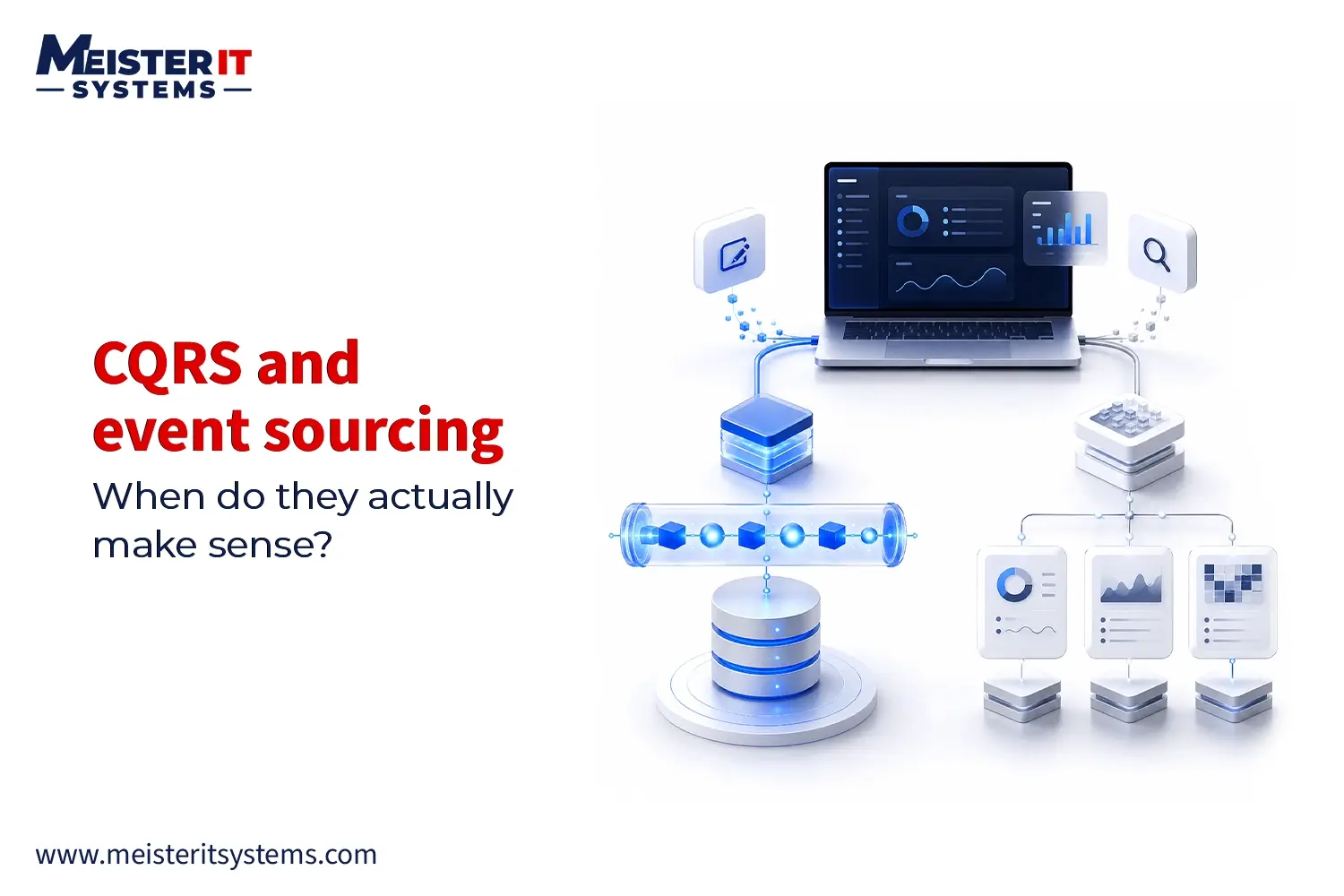
CQRS stands for Command Query Responsibility Segregation. The core principle is straightforward: the model you use to write data should be completely separate from the model you use to read it.
In most standard applications, a single unified domain model does everything. It validates business logic during writes, and it shapes data for the UI during reads. This works fine initially, but a major bottleneck appears at scale. The database structure optimized for complex write operations is almost always terrible for fast read queries, such as dashboard rendering. You end up with a single model doing two distinct jobs poorly.
CQRS splits your application traffic into two independent paths:
- Commands (Writes): These handle any action that changes system state. A command expresses explicit business intent, such as BookFlight or ProcessPayment. It executes business validation logic, updates the data store, and returns no data.
- Queries (Reads): These handle data fetching. They completely bypass heavy domain logic, hitting denormalized, flat read models to deliver data directly to the user interface as fast as possible.
Visualizing the Traffic Split
Traditional CRUD Architecture:
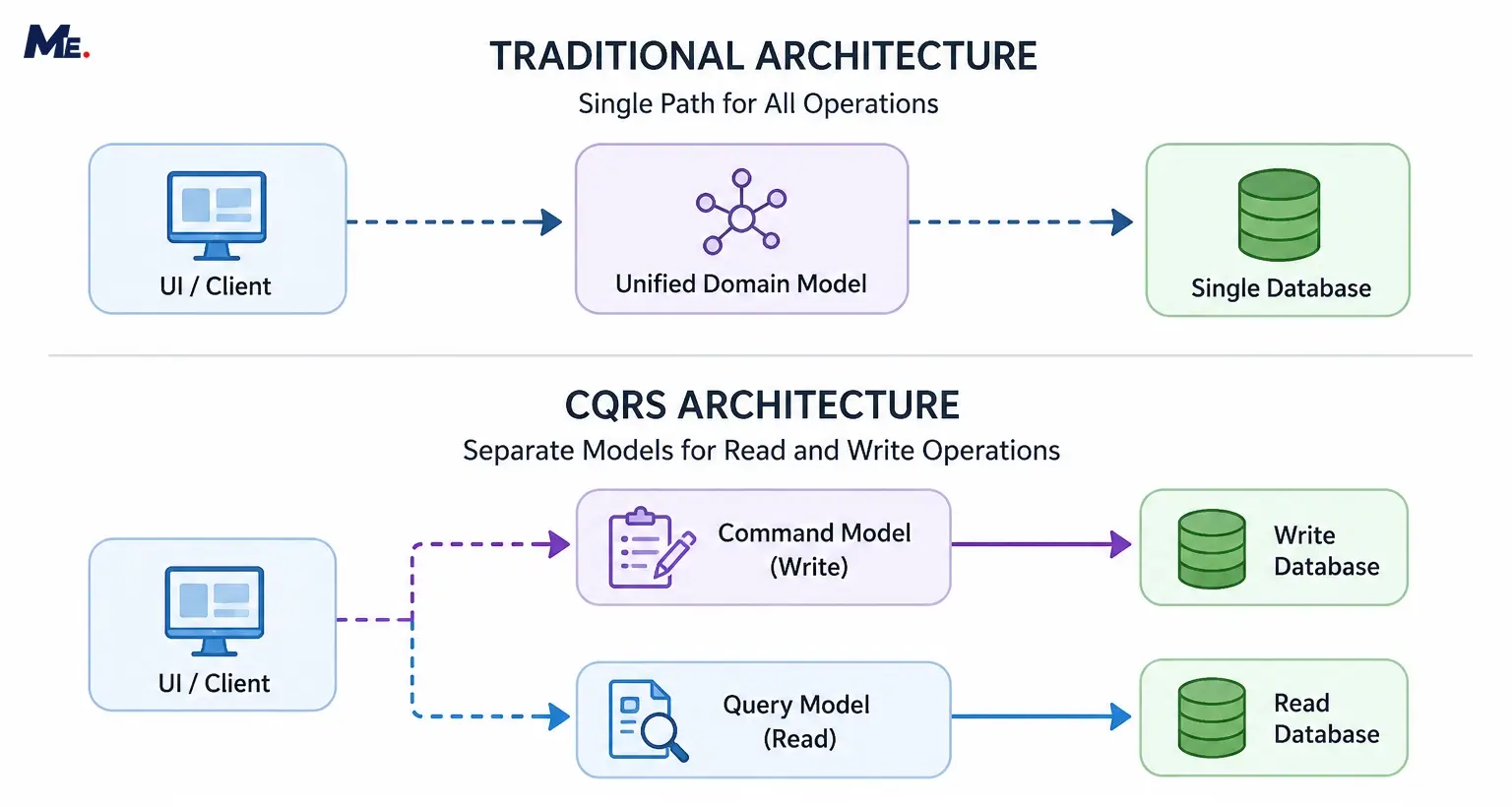
The big payoff: You can scale reads and writes completely independently. If your platform handles 100 reads for every single write, you can aggressively scale your read layer without paying to scale your write infrastructure.
What is Event Sourcing?
While CQRS splits your traffic paths, Event Sourcing fundamentally changes how you store your application state. Instead of keeping only the latest state of a record, an event-sourced system stores every single historical change as an immutable sequence of events.
Think of it like this: A traditional CRUD database only stores the final answer, whereas Event Sourcing stores the entire math equation.
CRUD approach: “User balance is $150.”
Event Sourcing approach:
- AccountOpened (+$0)
- FundsDeposited (+$200)
- FundsWithdrawn (-$50)
To determine the current state of a user’s account, the system replays these events from the beginning to calculate the balance. This provides an absolute, tamper-proof audit trail of everything that happened and exactly when it happened.
A Real-World Example: The Bank Transfer
Imagine a user transfers $100.
- In a standard CRUD system, the application runs an UPDATE SQL statement. The balance row overwrites from $500 to $400. Why did it change? Who authorized it? That context is gone forever unless you built a completely separate, custom audit logging system on top of your business logic.
- In an event-sourced system, the transfer triggers a command. The system validates the request to ensure sufficient funds, and appends a light, immutable event to the log: AccountDebited { Amount: 100, Target: “Rent” }.
If an unexpected balance anomaly pops up six months later, engineers don’t have to guess or dig through chaotic server logs. They simply pull the event log and trace the exact timeline with millisecond precision.
Benefits of CQRS and Event Sourcing
Implementing these patterns introduces real complexity, but the concrete business advantages are massive when applied correctly.
1. CQRS Advantages
- Independent Scaling: You can throw resources at read replicas during traffic spikes without touching or risking the stability of your core write database.
- Highly Focused Code: When you write models don’t have to worry about how data looks on a mobile dashboard; your business logic stays clean, readable, and focused.
2. Event Sourcing Advantages
- Time-Travel Debugging: Because you possess the full history of state changes, you can reconstruct the exact state of your production system at any specific second in the past to diagnose bugs with absolute certainty.
- Retroactive Analytics: If your product team wants to track a new metric, you don’t have to regret not tracking it sooner. You can write a new projection, replay your historical event log from day one, and backfill the new metric instantly.
- Blazing Fast Writes: Because event stores are append-only, write operations require no complex row locks or database contention. You are simply sticking a new line at the end of a log file.
When Should You Use CQRS and Event Sourcing?
CQRS and Event Sourcing are not designed for every application. They become valuable when your system faces scaling, compliance, or data-tracking challenges that traditional CRUD architectures struggle to handle.
You should consider these patterns when:
- Read traffic significantly exceeds write traffic
- Your platform processes millions of events daily
- Regulatory requirements demand complete audit trails
- Multiple services need to react to the same business event
- Historical state reconstruction is important
- Database contention is affecting application performance
For most startups, internal tools, and early-stage SaaS products, traditional CRUD architecture remains the simpler and more cost-effective choice.
Where These Patterns Run in Production
These are not academic experiments. The highest-traffic digital systems on earth rely on these architectures because standard CRUD databases fail under their massive scales.
- Amazon: The checkout and cart pipelines process millions of concurrent add-to-cart actions as fast, append-only operations. This prevents checkout flows from choking on database row locks during major shopping holidays like Black Friday.
- Netflix: The recommendation engine ingests your viewing history, likes, and interactions through a high-throughput write path. Separate machine learning processors consume this event stream asynchronously, pushing optimized results to a specialized read model that loads your home screen instantly.
- Fintech & Trading: Banking platforms utilize event sourcing because immutable ledgers are non-negotiable. Balances must be a mathematically verifiable sum of every transaction ever made to satisfy regulatory audits easily.
- Logistics & Healthcare: Tracking patient vitals or supply chain packages from PackagePicked to CustomsCleared requires an unassailable history where zero gaps in data are permitted.
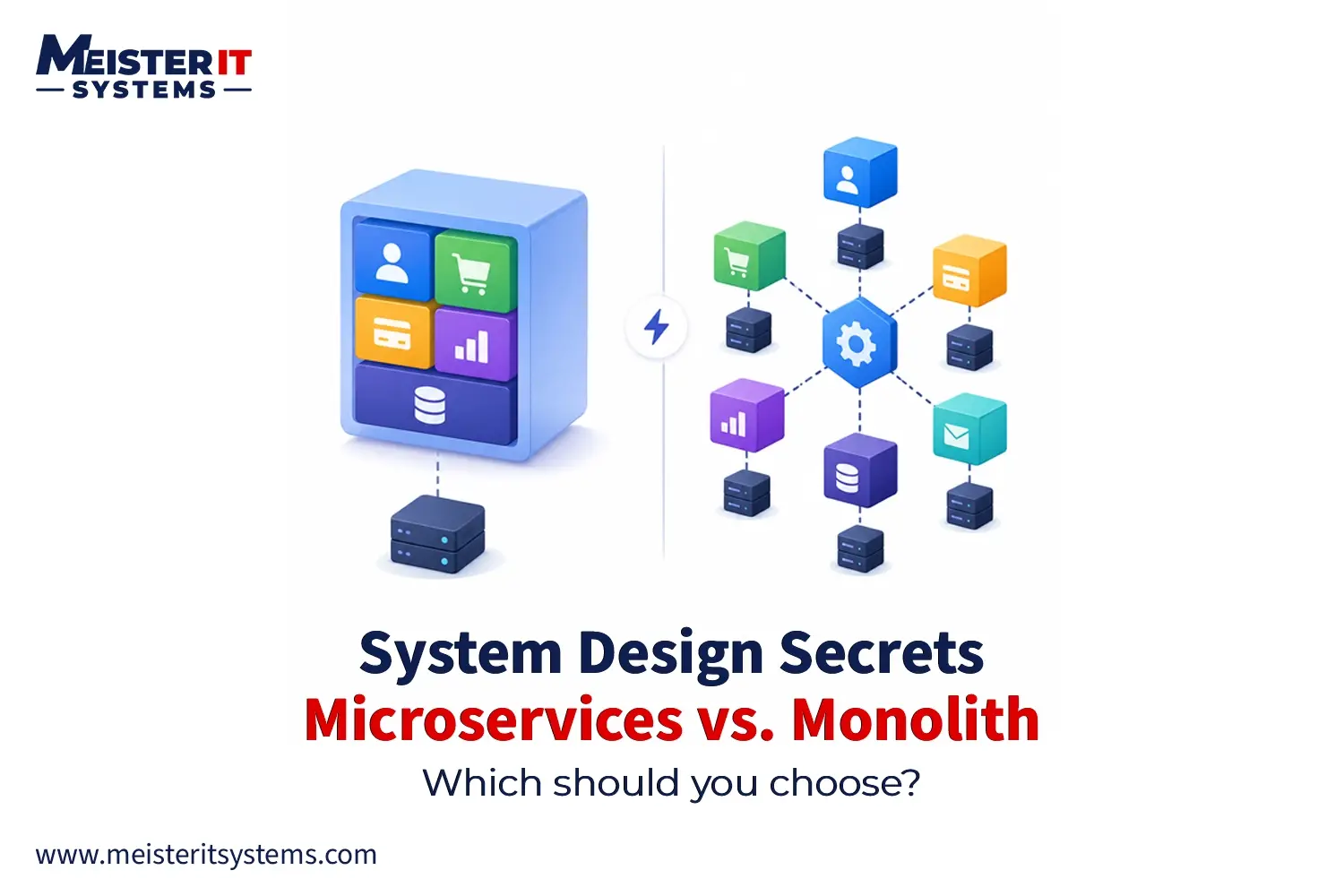
CQRS in a Microservices Architecture
In modern distributed systems, these patterns frequently serve as the foundational connective tissue that binds independent services together securely.
By leveraging an event broker like Apache Kafka, services communicate asynchronously. Each microservice maintains its own completely isolated read database, updating itself by listening to the shared event stream. If your analytics service experiences a brief outage, your main ordering service keeps accepting customer purchases completely uninterrupted. Failures remain strictly isolated.
What Most Engineering Teams Underestimate
These architectural patterns solve massive scaling bottlenecks, but they introduce unique engineering trade-offs that often shock unprepared teams.
1.Eventual Consistency is Real
Because the read models update asynchronously after a write event settles, there is a tiny window where a user might see slightly stale data immediately after hitting “submit.” Your frontend applications must be intentionally designed to mask this delay gracefully to avoid false bug reports.
2. Event Schemas Are Frozen in Time
An event written three years ago cannot be modified to fit a new database migration. When business requirements shift, you must implement a translation strategy (often called upcasting) to programmatically upgrade old event structures into new formats during live replays.
3. Extreme Infrastructure Complexity
You are replacing a straightforward database with a distributed ecosystem of command handlers, event stores, projection engines, message queues, and secondary data caches. Your DevOps and platform teams must have the operational maturity to monitor and maintain this ecosystem.
Architectural Comparison: CRUD vs. CQRS + Event Sourcing
| Feature | Traditional CRUD | CQRS + Event Sourcing |
|---|---|---|
| Data Model | Single unified model for reads and writes | Completely decoupled, specialized models |
| Scaling Strategy | Must scale the entire database layer together | Scale reads and writes completely independently |
| Data Consistency | Immediate and strongly consistent | Eventually consistent |
| Audit Trails | Requires manual, separate engineering work | Built directly into the core storage design |
| System Complexity | Low to Moderate | High |
| Best Used For | Standard web apps, CRUD tools, early MVP products | High-traffic scales, heavy audit compliance |
The honest recommendation: If you are running an early-stage startup, an internal tool, or a standard web application without massive traffic asymmetry, stick with traditional CRUD. Adding CQRS and Event Sourcing to a system that doesn’t genuinely demand it is simply engineering debt disguised as sophistication.
Conclusion
Deciding whether to pivot your infrastructure toward CQRS isn’t just a code pattern question; it is a deep systems architecture decision. It requires an honest look at your current scale, your team’s operational strengths, and your long-term business goals.
At MeisterIT Systems, we help engineering teams evaluate these structural decisions without the industry hype. We audit your existing architecture, identify exactly where database bottlenecks are threatening your performance, and design production-ready systems built to scale. Whether you need reliable event streaming with Apache Kafka, robust distributed transactions, or airtight compliance audit trails, our engineers have shipped it successfully.
If you are looking for a practical, battle-tested second opinion on your data architecture, let’s connect.
Frequently Asked Questions
Q1: What is the exact difference between CQRS and Event Sourcing?
A1: CQRS separates your application’s read paths from its write paths into distinct code models. Event Sourcing is a data-storage strategy that saves every state change as an unchangeable event rather than overwriting a database row. You can easily use CQRS on its own without using Event Sourcing, though they pair together beautifully.
Q2: When should you avoid using CQRS?
A2: Avoid it if your application has standard traffic, highly balanced read/write ratios, or basic data requirements. If your business doesn’t actively suffer from read/write infrastructure bottlenecks, CQRS will cost you far more in setup and maintenance complexity than it will ever return in performance gains.
Q3: Is Event Sourcing only meant for financial platforms?
A3: No. While it is standard in fintech, it is highly valuable for any domain that requires absolute historical records or deep data tracking. E-commerce platforms, patient tracking systems, complex logistics pipelines, and collaborative SaaS software all make heavy use of it.
Q4: What does eventual consistency mean for my users?
A4: It means that after a user submits a change, the read database might take a few milliseconds to catch up. For a brief split-second, reloading the page might show older data. To prevent users from thinking their action failed, frontends typically use optimistic UI updates to show the expected change immediately while the backend catches up.
Q5: How do these patterns improve a microservices setup?
A5: They decouple your services completely. Instead of Service A making a direct API call to Service B (which creates a brittle dependency), Service A simply flings an event onto a broker like Kafka. Service B processes it whenever it’s ready, keeping both systems running independently even if one goes down.