
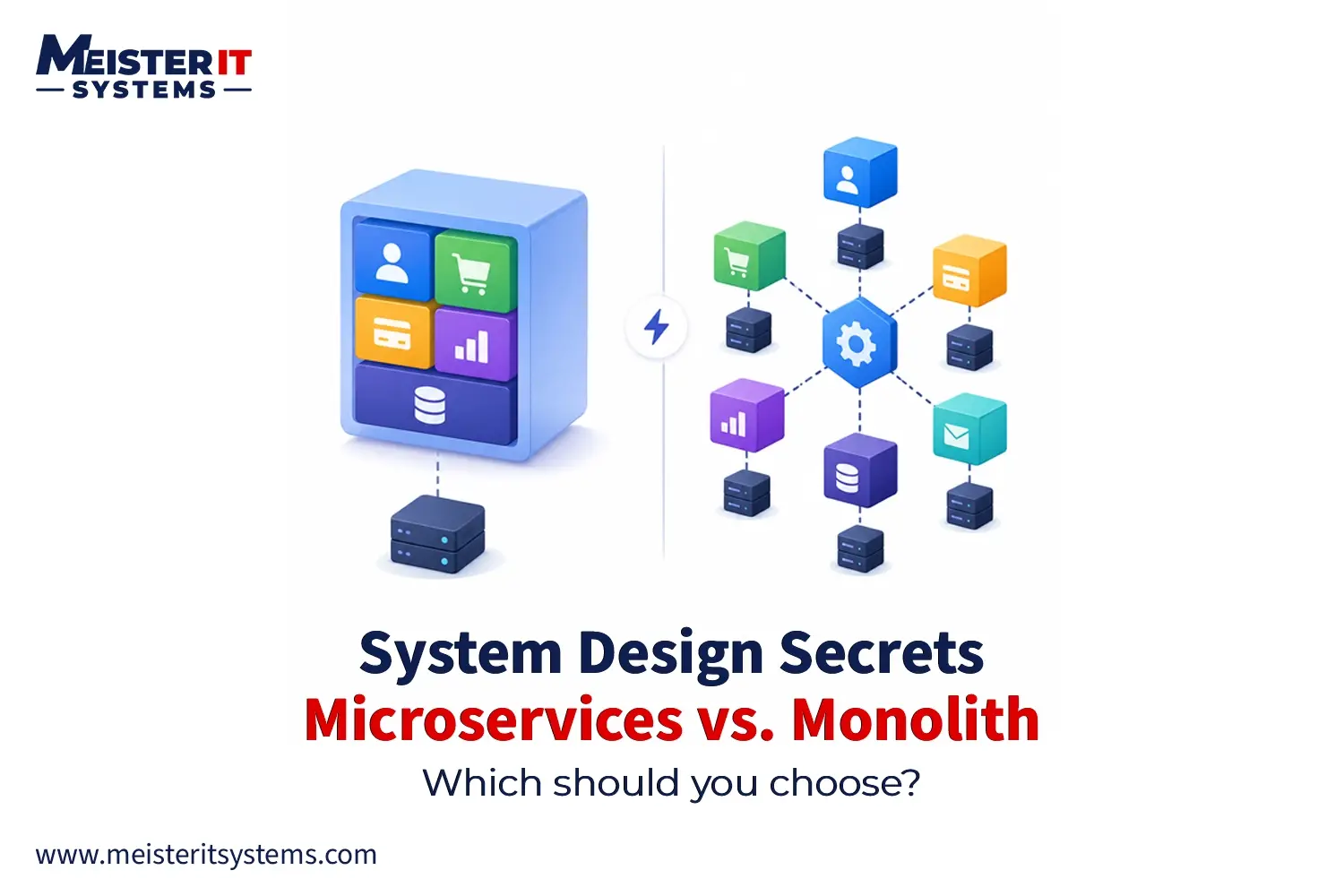
Choosing between Microservices and Monolithic Architecture affects how your application is developed, deployed, scaled, monitored, and secured.
A monolith can help a small engineering team ship quickly. However, it may become difficult to manage as the codebase, traffic, and number of developers grow. Microservices provide independent deployment and scaling, but they also introduce network failures, distributed data, and higher operational complexity.
Neither architecture is automatically better. The right choice depends on your product, team structure, workload, and ability to operate the system in production.
Quick Answer
A monolithic architecture is usually the better choice for MVPs, small teams, and applications with straightforward requirements. Microservices are better suited to complex platforms that need independent deployments, targeted scaling, fault isolation, and separate team ownership. For many SaaS products, a modular monolith is the safest starting point.
What is Monolithic Architecture?
A monolithic architecture combines an application’s main components into one deployable unit.
The user interface, business logic, integrations, and data access layers may be separated inside the codebase. However, they are normally built, tested, and deployed together.
For example, an ecommerce monolith might include:
- User authentication
- Product management
- Shopping cart
- Payment processing
- Order management
- Customer notifications
These modules run within the same application. If developers change the payment module, they usually rebuild and deploy the complete application.
However, monolithic architecture does not mean poorly structured code. A well-designed modular monolith can maintain clear boundaries between business domains while keeping deployment and operations simple.
How Does a Monolithic Application Work?
A typical monolithic application has three main layers.
1. Presentation layer
The presentation layer manages the user interface and incoming requests. It may include a website, mobile API, or administrative dashboard.
2. Business logic layer
This layer processes application rules. It may calculate prices, validate orders, enforce permissions, or manage subscription plans.
3. Data access layer
The data access layer reads and writes information to a shared database. It also manages queries, connections, and transactions.
These layers normally run within one process. They communicate through internal function calls instead of network requests. As a result, communication is fast and application flows are easier to trace.
Advantages of Monolithic Architecture
A monolithic architecture remains a practical option for many software products.
1. Faster initial development
Developers can work in one repository and run the complete application locally.
The team does not need to configure service discovery, API gateways, message brokers, or distributed tracing before building the core product. This reduces initial setup and helps teams validate ideas faster.
2. Simpler deployment
A monolith generally uses one primary build and deployment pipeline.
The team packages and deploys the complete application as a container, virtual machine image, or platform-specific build. Smaller teams can manage this process without maintaining separate pipelines for multiple services.
3. Easier testing and debugging
Developers can test the complete request flow inside one application.
Logs, stack traces, and application state are easier to follow. Integration tests also require fewer external dependencies and test environments.
4. Strong data consistency
Most monolithic applications use a shared relational database.
The application can update several tables inside one database transaction. If one operation fails, the database can roll back the complete transaction.
This is simpler than maintaining consistency across several independently managed databases.
5. Lower operational overhead
A monolith usually requires fewer infrastructure components.
The team manages fewer deployment configurations, access policies, monitoring dashboards, security controls, and runtime environments. This can reduce cloud costs and engineering effort during the early stages of a product.
Limitations of Monolithic Architecture
Problems start when internal boundaries weaken or too many teams depend on the same release process.
1. The complete application scales together
Suppose product search consumes most of the application’s CPU and memory. The team may need to create more instances of the complete monolith, even though other functions require no additional capacity.
This can waste infrastructure resources and increase cloud costs.
2. Small changes require full deployment
A minor change to one module may require the complete application to be rebuilt, tested, and deployed.
As the codebase grows, releases can take longer. Several teams may also need to coordinate changes before a production deployment.
3. Failures can affect unrelated features
A memory leak, blocked thread, or resource-intensive process can affect other modules running inside the same application.
Load balancing and multiple application instances can improve availability. However, they do not always provide workload-level isolation.
4. The codebase can become tightly coupled
Poor boundaries allow one module to access another module’s logic or data directly.
Over time, developers may struggle to predict how a change will affect the rest of the system. Tests become slower, deployments become riskier, and technical debt grows.
5. Technology changes become expensive
A monolith normally uses one primary programming language, framework, and runtime.
Upgrading a major dependency can affect the entire codebase. Replacing one technology may also require changes across several unrelated features.
What is Microservices Architecture?
Microservices architecture divides an application into smaller, independently deployable services.
Each service focuses on a specific business capability. It may have its own codebase, runtime, deployment pipeline, and database.
For example, an ecommerce platform could use separate services for:
- Identity and access
- Product catalog
- Inventory
- Payments
- Orders
- Shipping
- Notifications
These services communicate through REST APIs, gRPC, message queues, or event streams.
Each service can be developed, deployed, monitored, and scaled independently. However, the complete platform becomes a distributed system with more failure points and operational requirements.
How Do Microservices Communicate?
Microservices commonly use synchronous or asynchronous communication.
1. Synchronous communication
A service sends a request and waits for an immediate response.
REST APIs and gRPC are common choices. They work well when the calling service needs an immediate result.
However, synchronous communication creates a runtime dependency. If the receiving service becomes slow or unavailable, the calling service may also fail.
Teams need controls such as:
- Request timeouts
- Controlled retries
- Circuit breakers
- Rate limits
- Fallback responses
- Bulkhead isolation
Retries must be used carefully. Uncontrolled retries can increase traffic during an outage and make the failure worse.
2. Asynchronous communication
A service publishes a message or event without waiting for another service to complete its work.
Platforms such as Apache Kafka, RabbitMQ, and AWS SQS support asynchronous communication. This approach can reduce direct dependencies and improve workload resilience.
However, event-driven communication introduces other challenges:
- Duplicate messages
- Out-of-order delivery
- Event versioning
- Retry handling
- Dead-letter queues
- Eventual consistency
- Failed event processing
Consumers should be idempotent. Processing the same event more than once should not create duplicate records or incorrect state.
Advantages of Microservices Architecture
Microservices provide value when a platform has clear business domains and genuine requirements for independent operation.
1. Independent deployment
Teams can release one service without redeploying the complete application.
For example, developers can update the notification service without changing the payment or inventory services. This supports smaller releases and reduces coordination between teams.
2. Targeted scaling
Each service can scale according to its workload.
During a major ecommerce sale, the product catalog and checkout services may need additional resources. Meanwhile, reporting and administrative services can continue running at their normal capacity.
3. Clear team ownership
A team can own a service from development through production.
This ownership can include:
- Application code
- Database schema
- Deployment pipeline
- Monitoring
- Security
- Incident response
Clear ownership reduces dependencies between teams and makes production responsibility easier to identify.
4. Better fault isolation
A failure in the notification service should not prevent customers from placing orders.
However, splitting an application into services does not automatically create resilience. Teams must prevent unnecessary synchronous dependencies and define fallback behavior for unavailable services.
5. Technology flexibility
Different services can use different technologies when there is a clear technical reason.
For example, a platform may use:
- Node.js for API-heavy services
- Python for AI and data processing
- Java for transaction-heavy systems
- Go for high-throughput infrastructure services
Technology diversity also creates maintenance overhead. Organizations should define a controlled set of approved languages, frameworks, databases, and deployment patterns.
Limitations of Microservices Architecture
Microservices do not remove complexity. They move much of it from the application into infrastructure and operations.
1. Higher operational complexity
Every service needs to be deployed, configured, secured, monitored, and maintained.
A production microservices platform may require:
- Container orchestration
- CI/CD pipelines
- Service discovery
- API gateway
- Secrets management
- Centralized logging
- Distributed tracing
- Infrastructure automation
- Message brokers
- Service-level monitoring
Without mature DevOps practices, operating the system can consume more engineering time than building product features.
2. Technology changes become expensive
Each service should normally own its data. Other services should access that data through an API or event.
This improves independence but makes cross-service transactions harder.
Consider an order workflow:
- The order service creates an order.
- The payment service processes the payment.
- The inventory service reserves the products.
- The shipping service creates a delivery request.
- The notification service sends confirmation.
If inventory reservation fails after payment succeeds, the platform needs a recovery process. It may cancel the order, issue a refund, or retry the reservation.
Patterns such as Saga and Transactional Outbox can support these workflows. However, they require careful design, idempotency, monitoring, and reconciliation.
3. Network latency and failure
A function call inside a monolith runs within one process. A request between microservices travels across a network.
This introduces:
- Latency
- Timeouts
- Connection failures
- Authentication overhead
- Serialization costs
- Partial system failures
Teams must assume that every remote request can fail.
4. More complex testing
Testing a single service is straightforward. Testing a complete user journey across several services is more difficult.
A microservices testing strategy may require:
- Unit tests
- Integration tests
- API contract tests
- Component tests
- End-to-end tests
- Resilience tests
- Production smoke tests
Contract testing is particularly important. It verifies that a service update does not break its consumers.
5. Stronger observability requirements
Application logs are not enough when one request travels through several services.
Teams need correlation IDs and distributed tracing to follow the complete request path. They also need centralized logs, metrics, dashboards, service-level objectives, and actionable alerts.
Without these capabilities, identifying the cause of a production failure can take longer than it would in a monolithic application.
Microservices vs Monolithic Architecture: Key Differences
The following table compares both architecture models across development and production operations.
| Criteria | Monolithic Architecture | Microservices Architecture |
|---|---|---|
| Application structure | One deployable application | Multiple independent services |
| Deployment | Complete application deployed together | Services deployed separately |
| Communication | Internal function calls | APIs, gRPC, queues, or events |
| Scaling | Complete application usually scales | Individual services scale independently |
| Data management | Shared database is common | Each service should own its data |
| Transactions | Local database transactions | Often requires eventual consistency |
| Testing | Simpler integration testing | Requires contract and distributed testing |
| Failure impact | Failure may affect the wider application | Failure can be isolated by service |
| Monitoring | Centralized application monitoring | Distributed observability is required |
| Technology stack | Usually consistent | Can vary between services |
| Team structure | Works well for smaller teams | Supports several autonomous teams |
| Initial cost | Lower | Higher |
| Operational complexity | Lower | Higher |
When Should You Choose Monolithic Architecture?
A monolithic architecture is a strong choice when simplicity and delivery speed matter more than service independence.
Consider a monolith when:
- You are building an MVP.
- One small team owns the application.
- The business domain is still changing.
- Traffic is moderate and predictable.
- Strong transactional consistency is important.
- Your team has limited DevOps resources.
- Independent service scaling is not required.
- You need to validate the product quickly.
You should still enforce internal module boundaries. A monolith without structure can become difficult to maintain before it reaches significant traffic.
When Should You Choose Microservices Architecture?
Choose microservices when the system has clear technical or organizational reasons for independent services.
Microservices may be appropriate when:
- Different workloads have different scaling requirements.
- Several teams need to deploy independently.
- The platform has clear business domains.
- Individual workloads require fault or security isolation.
- The organization has mature CI/CD practices.
- Centralized logging and distributed tracing are available.
- Teams can manage eventual consistency.
- Service ownership is clearly defined.
- Independent releases provide measurable business value.
Do not choose microservices only because you expect the application to grow. A well-designed monolith can support significant traffic.
What is a Distributed Monolith?
A distributed monolith consists of separate services that remain tightly coupled.
Common warning signs include:
- Every service shares the same database.
- Services must be deployed together.
- One request triggers a long chain of synchronous service calls.
- Teams cannot change an API without coordinating several releases.
- A failure in one service affects the complete platform.
- Business logic has no clear owner.
A distributed monolith combines the operational cost of microservices with the coupling of a traditional monolith.
To avoid it, define clear service boundaries, assign data ownership, use stable contracts, and reduce unnecessary runtime dependencies.
How to Migrate From a Monolith to Microservices
Avoid rewriting the complete application at once. A full rewrite increases delivery risk and may reproduce the same design problems in a new system.
Use an incremental migration process instead.
1. Identify the current constraint
Start with a measurable problem.
One module may require frequent deployments, consume most of the CPU, or cause failures in unrelated features.
2. Map business domains
Group application capabilities around business responsibilities.
Billing, authentication, orders, and notifications are stronger service boundaries than controllers, database queries, or utility functions.
3. Select a low-risk capability
Choose a module with limited dependencies.
Notifications, document processing, search, reporting, and media processing are often safer starting points than payments or order management.
4. Define the service contract
Specify the service’s:
- API endpoints
- Request and response schemas
- Authentication method
- Data ownership
- Timeout behavior
- Error responses
- Event formats
A stable contract allows the service and the remaining monolith to evolve independently.
5. Extract the service gradually
Route selected requests to the new service while the rest of the application remains inside the monolith.
This approach is commonly known as the strangler pattern.
6. Measure the result
Track deployment time, error rate, latency, infrastructure usage, recovery time, and operational effort.
The migration should improve a measurable outcome. Otherwise, it may only add more components to manage.
Common Architecture Mistakes
Architecture problems often begin when teams select a pattern before understanding the workload.
1. Creating too many services
Small services are not automatically good services.
Every service introduces another deployment, API contract, monitoring configuration, and potential network failure. Start with larger business boundaries and split them only when necessary.
2. Using microservices without DevOps maturity
Manual deployments and weak monitoring do not scale across multiple services.
Before adopting microservices, establish automated testing, infrastructure as code, centralized observability, secrets management, and reliable deployment pipelines.
3. Sharing one database across every service
A shared database allows services to change each other’s data directly.
This creates hidden dependencies and prevents independent deployment. Each service should control its own schema and expose data through an API or event.
4. Ignoring failure scenarios
Service communication will fail eventually.
Define what happens when a dependency is slow, unavailable, or returns invalid data. Apply timeouts, controlled retries, circuit breakers, idempotency, and fallback behavior where appropriate.
5. Migrating without clear metrics
“Moving to microservices” is not a measurable objective.
A migration should improve outcomes such as:
- Deployment frequency
- Release lead time
- Recovery time
- Workload isolation
- Infrastructure efficiency
- Team ownership
If these metrics do not improve, the new architecture may not be delivering enough value to justify its complexity.
Build the Right Architecture With MeisterIT Systems
Architecture decisions should be based on real workloads, team capacity, security requirements, and growth plans. Choosing the wrong model can increase cloud costs, slow releases, and create technical debt that becomes expensive to remove.
MeisterIT Systems is an expert software development partner helping businesses design, build, and modernize scalable applications. Our technology experts support the complete process, including architecture planning, technology selection, cloud infrastructure, DevOps automation, software development, and performance optimization.
Conclusion
The choice between microservices vs monolithic architecture should not depend on which model appears more modern.
A monolithic architecture provides faster development, simpler testing, strong data consistency, and lower operational overhead. Microservices provide independent deployment, targeted scaling, workload isolation, and clearer ownership across multiple teams.
For many new SaaS applications, a modular monolith is the right starting point. Move selected capabilities to microservices only when scaling, deployment, security, or ownership constraints justify the additional complexity.
MeisterIT Systems is an expert software development company to build a secure, scalable, and production-ready application.
Book a free consultation today.
Frequently Asked Questions
Q1: Is microservices architecture better than monolithic architecture?
A1: Microservices are not automatically better. They provide independent deployment and scaling but also introduce distributed data and operational complexity. A monolith is often more efficient for smaller applications and teams.
Q2: Can a monolithic application handle high traffic?
A2: Yes. A monolith can support high traffic through horizontal scaling, caching, load balancing, database optimization, and background processing. Its main limitation is that the complete application usually scales as one unit.
Q3: Should startups use microservices?
A3: Most startups should begin with a modular monolith. This approach allows the team to validate the product quickly while maintaining clear boundaries for future service extraction.
Q4: When should you break a monolith into microservices?
A4: Consider microservices when a specific component requires independent scaling, deployment, ownership, security, or fault isolation. Do not migrate only because the codebase has become large.
Q5: Are microservices more expensive?
A5: Microservices usually cost more to build and operate initially. Each service requires deployment infrastructure, monitoring, security controls, and ongoing maintenance. However, targeted scaling may improve infrastructure efficiency for large or uneven workloads.
Q6: Can monolithic and microservices architectures work together?
A6: Yes. A business can keep its core application as a monolith while operating selected workloads as separate services. This hybrid model supports gradual modernization and reduces migration risk.