
Introduction
Artificial Intelligence is transforming how businesses access information, automate workflows, and serve customers. However, traditional AI models often struggle with outdated knowledge, inaccurate responses, and limited access to company-specific data. This is where Retrieval-Augmented Generation (RAG) comes in.
So, what is Retrieval-Augmented Generation, and why is it becoming a critical component of enterprise AI strategies? RAG combines the power of large language models with real-time information retrieval, enabling AI systems to deliver more accurate, relevant, and context-aware responses.
In this article, you’ll learn what Retrieval-Augmented Generation (RAG) is, how it works, the business challenges it solves, and why organizations across industries are adopting it to improve decision-making, customer experiences, and operational efficiency.
What is Retrieval-Augmented Generation (RAG)?
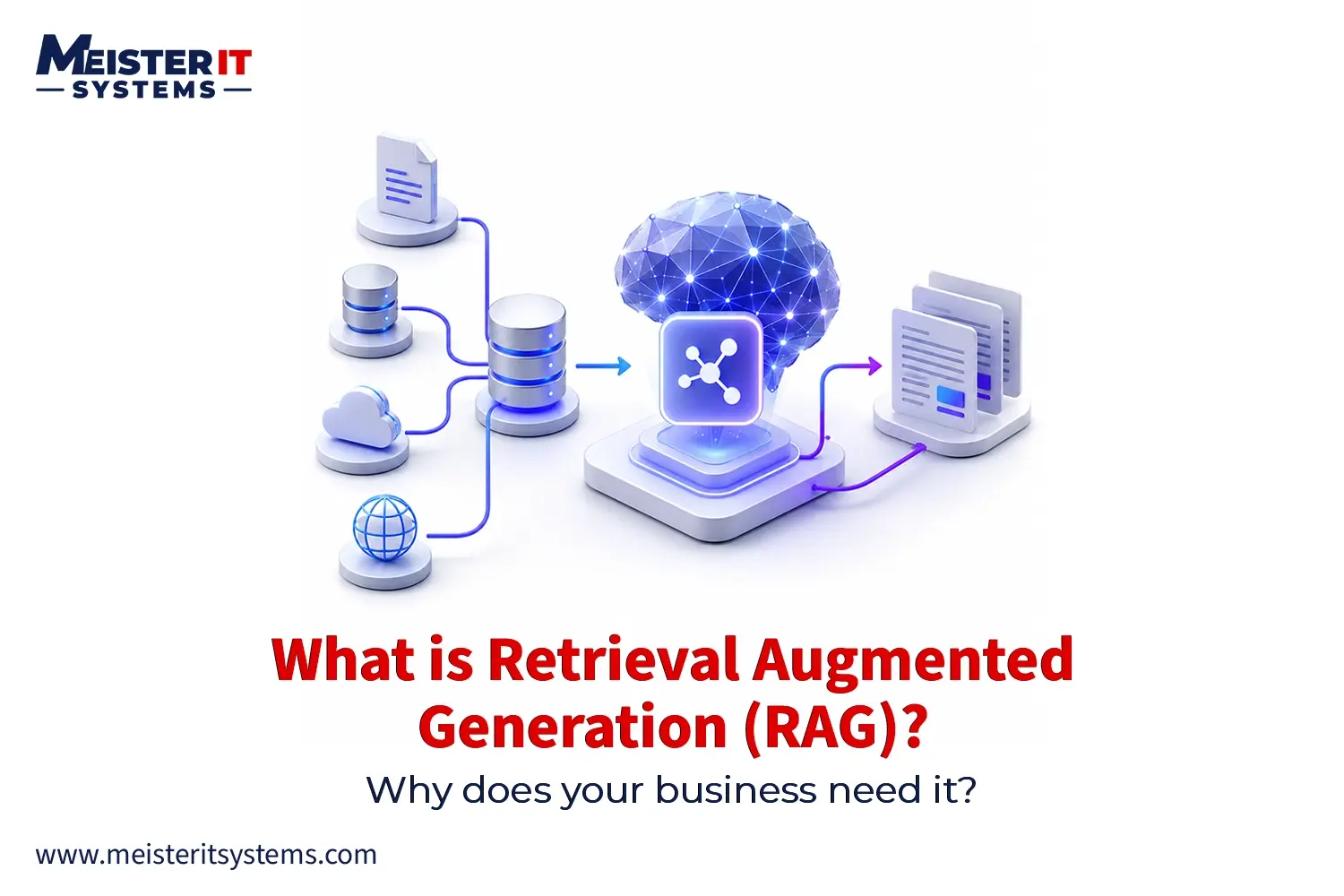
Retrieval-Augmented Generation (RAG) is an AI framework that enhances the capabilities of Large Language Models by allowing them to retrieve relevant information from external data sources before generating a response.
Instead of relying solely on the information contained within a model’s training data, RAG enables AI systems to access current and organization-specific knowledge, such as:
- Internal documents
- Knowledge bases
- Product manuals
- CRM systems
- Enterprise databases
- Wikis and intranets
- Customer support resources
The retrieved information is then provided to the AI model as context, allowing it to generate responses based on accurate and up-to-date information.
In simple terms, RAG gives AI access to your business knowledge before it answers a question.
Why Traditional AI Models are not enough for businesses
While Generative AI tools have demonstrated remarkable capabilities, they often struggle in enterprise environments.
1. Limited Knowledge
Most AI models are trained on historical datasets and may not be aware of recent business updates, product changes, or internal company information.
2. AI Hallucinations
One of the biggest concerns with traditional AI systems is hallucination, where the model generates responses that sound convincing but are factually incorrect.
3. Lack of Business Context
Every organization has unique processes, policies, products, and terminology. Standard AI models do not inherently understand these details.
4. Data Accessibility Challenges
Employees often spend significant time searching through multiple systems, documents, and databases to find information. Traditional AI cannot effectively bridge these information silos without access to organizational data.
As businesses increasingly depend on AI for critical tasks, accuracy and reliability become essential. RAG addresses these challenges by connecting AI directly to trusted knowledge sources.
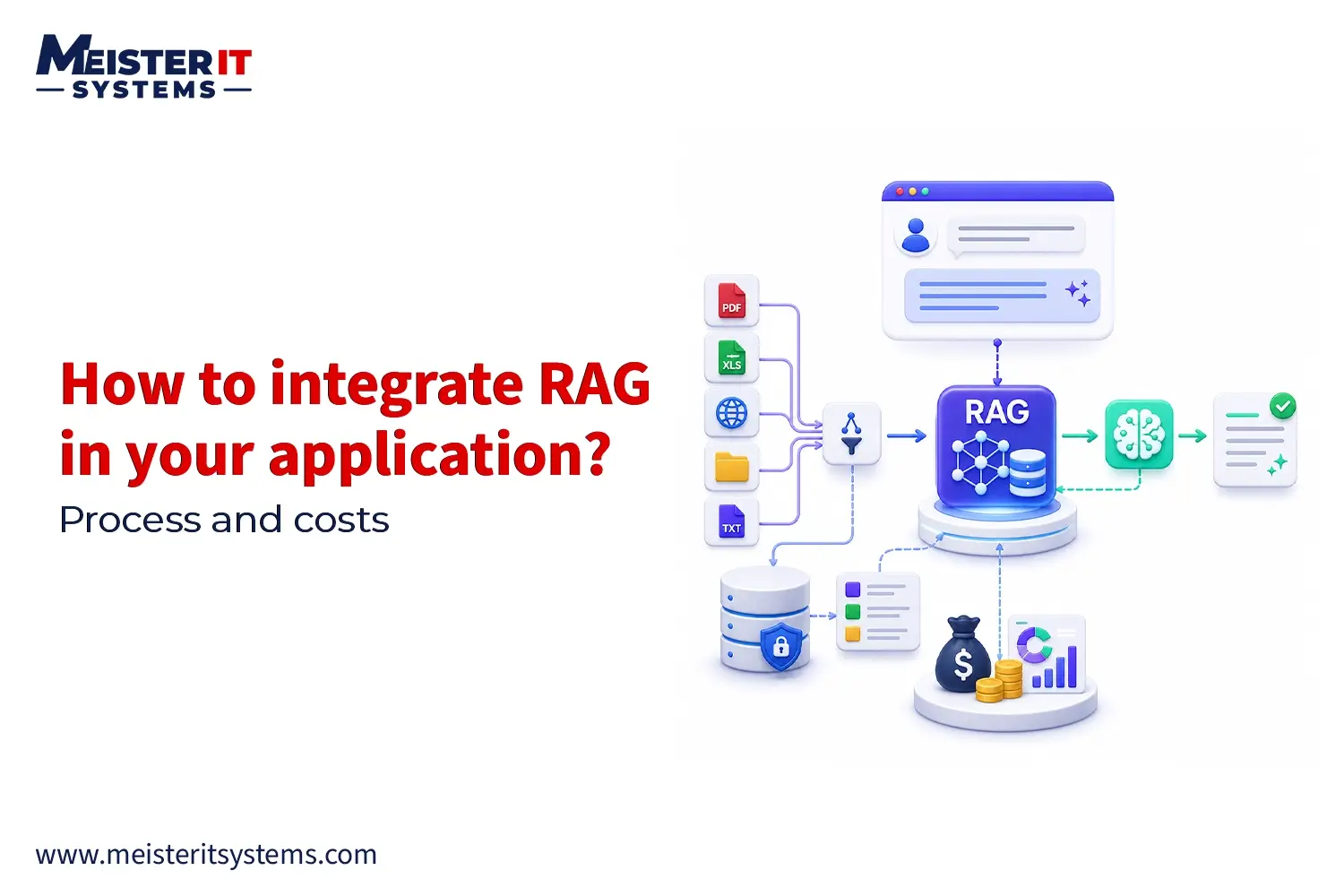
How Retrieval-Augmented Generation(RAG) works
The process behind RAG can be understood through four simple steps:
1. A user asks a question
A customer, employee, or business user submits a query.
For example:
“What is our company’s refund policy for enterprise customers?”
2. Relevant information is retrieved
The RAG system searches connected knowledge sources to identify documents, records, or content related to the query.
3. Context is added
The retrieved information is provided to the AI model as additional context.
4. AI generates a response
Using both its language capabilities and the retrieved information, the AI generates a response that is more accurate, relevant, and aligned with business knowledge.
This combination of retrieval and generation enables AI systems to deliver answers that are grounded in real organizational data.
Why does your business need RAG?
As organizations expand their digital operations, the amount of business knowledge grows exponentially. Information becomes scattered across systems, departments, and documents.
RAG helps businesses unlock the value of this information.
1. Improved Accuracy
Since responses are generated using current and verified data, RAG significantly improves the accuracy of AI-generated content.
This is especially important for industries where incorrect information can result in operational, financial, or compliance risks.
2. Reduced AI Hallucinations
By grounding responses in actual business data, RAG minimizes the risk of fabricated or misleading answers.
This increases trust in AI systems among employees and customers.
3.Real-Time Access to Information
Business information changes constantly.
- Policies evolve.
- Products are updated.
- Regulations change.
RAG allows AI systems to access the latest information without requiring expensive model retraining.
4. Better Customer Support
Customers expect quick and accurate responses.
RAG-powered support assistants can instantly retrieve information from product documentation, FAQs, and knowledge bases to provide faster and more relevant answers.
5. Improved Employee Productivity
Employees often spend hours searching for information across multiple systems.
RAG simplifies knowledge discovery by providing instant answers from enterprise data sources, helping teams work more efficiently.
6. Greater Value from Existing Data
Many organizations already possess vast amounts of valuable information that remain underutilized.
RAG transforms these knowledge assets into accessible resources that employees and customers can interact with through natural language.
7. Cost-Effective AI Adoption
Training or fine-tuning large AI models can be expensive and time-consuming.
RAG offers a more practical alternative by allowing businesses to improve AI performance through data retrieval rather than repeated model retraining.
Common business use cases of RAG
Organizations across industries are adopting Retrieval-Augmented Generation to solve real-world challenges.
1. Customer Support
AI assistants can access product manuals, troubleshooting guides, and support documentation to answer customer questions more accurately.
2. Enterprise Knowledge Management
Employees can quickly find policies, procedures, and internal documentation without manually searching through multiple systems.
3. Intelligent Enterprise Search
RAG improves enterprise search by delivering direct answers instead of simply returning lists of documents.
4. HR and Employee Assistance
Human Resources teams can deploy AI assistants that provide instant answers about benefits, onboarding processes, leave policies, and company guidelines.
5. Financial Services
Financial institutions use RAG to retrieve information from regulatory documents, compliance policies, and customer records.
6. Healthcare
Healthcare organizations can leverage RAG to assist with medical documentation, clinical knowledge retrieval, and operational workflows while maintaining access to updated information.
7. E-commerce
Online retailers can improve product discovery, customer support, and shopping experiences through AI systems powered by real-time product information.
Key benefits of RAG for enterprises
Businesses investing in RAG solutions often experience measurable improvements in several areas:
- Faster access to knowledge
- Increased employee productivity
- Improved customer satisfaction
- More accurate AI responses
- Reduced operational inefficiencies
- Better utilization of business data
- Lower AI maintenance costs
- Stronger decision-making capabilities
These benefits make RAG one of the most practical approaches for deploying enterprise AI at scale.
RAG vs Traditional AI Models
| Traditional AI Models | Retrieval-Augmented Generation |
|---|---|
| Depend on training data | Access external knowledge sources |
| Knowledge can become outdated | Retrieves current information |
| Higher risk of hallucinations | More accurate and grounded responses |
| Limited business context | Uses organization-specific data |
| Requires retraining for updates | Updates through connected data sources |
For most enterprise use cases, RAG offers a more scalable and reliable approach to AI deployment.
Is your business ready for RAG?
Your organization may benefit from Retrieval-Augmented Generation if:
- Employees struggle to find information quickly
- Customer support teams manage large knowledge bases
- Critical information exists across multiple systems
- AI-generated inaccuracies create business risks
- You want to improve enterprise search capabilities
- Your organization is investing in Generative AI initiatives
As enterprise data continues to grow, organizations that can effectively connect AI with business knowledge will gain a significant competitive advantage.
How Meister IT Systems can help
Successfully implementing RAG requires more than simply connecting an AI model to a database. Organizations need the right architecture, data strategy, security controls, and integration approach to achieve meaningful business outcomes.
At MeisterIT Systems, we help businesses design, develop, and deploy enterprise-grade RAG solutions tailored to their unique requirements. From knowledge management systems and intelligent search platforms to AI-powered customer support applications, our team helps organizations unlock the full value of their data through practical AI implementation.
Conclusion
Retrieval-Augmented Generation (RAG) is transforming how businesses use AI by combining the power of Large Language Models with access to real-time, organization-specific information. Unlike traditional AI systems that rely solely on pre-trained knowledge, RAG delivers more accurate, relevant, and trustworthy responses by grounding outputs in reliable data sources.
This helps reduce hallucinations, improve decision-making, enhance customer experiences, and unlock the full value of enterprise knowledge. As businesses continue to invest in AI, RAG offers a practical and scalable approach to building intelligent solutions that drive measurable results and long-term competitive advantage.
Ready to explore how RAG can benefit your business?
Contact us today to discuss your AI goals today to discuss your AI goals and discover how Meister IT Systems can help you build smarter, data-driven AI solutions.
Frequently Asked Questions (FAQs)
Q1: What is Retrieval-Augmented Generation (RAG) in simple terms?
A1: Retrieval-Augmented Generation (RAG) is an AI framework that combines the language capabilities of Large Language Models (LLMs) with the ability to retrieve information from external data sources. This allows AI systems to generate responses based on current and relevant information rather than relying solely on their training data.
Q2: Why is RAG important for businesses?
A2: RAG helps businesses improve the accuracy, reliability, and relevance of AI-generated responses. By connecting AI systems to internal knowledge bases, documents, and databases, organizations can reduce misinformation, improve customer support, and make better use of their existing data.
Q3: How does RAG reduce AI hallucinations?
A3: Traditional AI models can sometimes generate incorrect or fabricated information. RAG reduces hallucinations by retrieving relevant information from trusted sources and providing it to the AI model before it generates a response, resulting in more accurate and grounded answers.
Q4: What are the common use cases of Retrieval-Augmented Generation?
A4: RAG is widely used for customer support chatbots, enterprise search, knowledge management systems, employee assistants, document intelligence, healthcare information retrieval, financial services, and e-commerce applications.
Q5: What is the difference between RAG and fine-tuning?
A5: Fine-tuning involves retraining a model on specific datasets to improve its performance for certain tasks. RAG, on the other hand, retrieves information from external sources at the time of a query. This makes RAG more flexible, easier to update, and often more cost-effective for businesses dealing with frequently changing information.
Q6: Is Retrieval-Augmented Generation suitable for small and medium-sized businesses?
A6: Yes. RAG can benefit organizations of all sizes. Small and medium-sized businesses can use RAG-powered solutions to improve customer support, streamline knowledge sharing, enhance employee productivity, and gain more value from their existing business data without investing in expensive model retraining.