
Introduction
Retrieval-Augmented Generation (RAG) is booming across enterprise search ecosystems. Yet, the corporate landscape is littered with failed AI proof of concepts.
Building a basic prototype over a weekend is simple. Scaling it for production is entirely different. Your pipeline must handle millions of secure, fast-changing documents using advanced DevOps automation.
When user adoption grows, basic vector search cracks under pressure. This deep dive covers the exact engineering trade-offs required to deploy a resilient, enterprise-grade RAG platform.
What is a Production-Ready RAG Pipeline?
A production-ready RAG pipeline is an enterprise AI architecture that combines hybrid retrieval, automated data indexing, strict access governance, and LLM orchestration to deliver highly accurate, grounded, and scalable AI responses using live, real-time business knowledge.
Prototype RAG vs. Enterprise RAG Platforms at Scale
Many organizations start their generative AI journey by building a simple prototype using a few static PDFs, a basic open-source vector database, and a single API call to a large language model. This naive setup works fine in isolation because the data volume is minimal and the query intent is highly predictable.
The reality changes completely when you deploy to thousands of concurrent users across a global corporate network.
| Feature / Metric | Prototype RAG | Enterprise RAG Platform |
|---|---|---|
| Data Volume | A few PDFs and text files | Millions of documents, tables, and databases |
| Ingestion Style | Manual scripts and static uploads | Automated pipelines with Change Data Capture (CDC) |
| Search Mechanics | Pure semantic vector search | Hybrid retrieval (Vector + BM25) with reranking |
| Data Freshness | Completely static or batch-heavy | Real-time incremental indexing updates |
| Access Control | None (all users see all data) | Role-Based Access Control (RBAC) synchronization |
| Primary Bottleneck | LLM token generation latency | Vector database infrastructure and indexing bottlenecks |
A prototype merely validates a technical concept. An enterprise system must deliver precise, highly compliant business value every single second without hallucinations or data leaks.
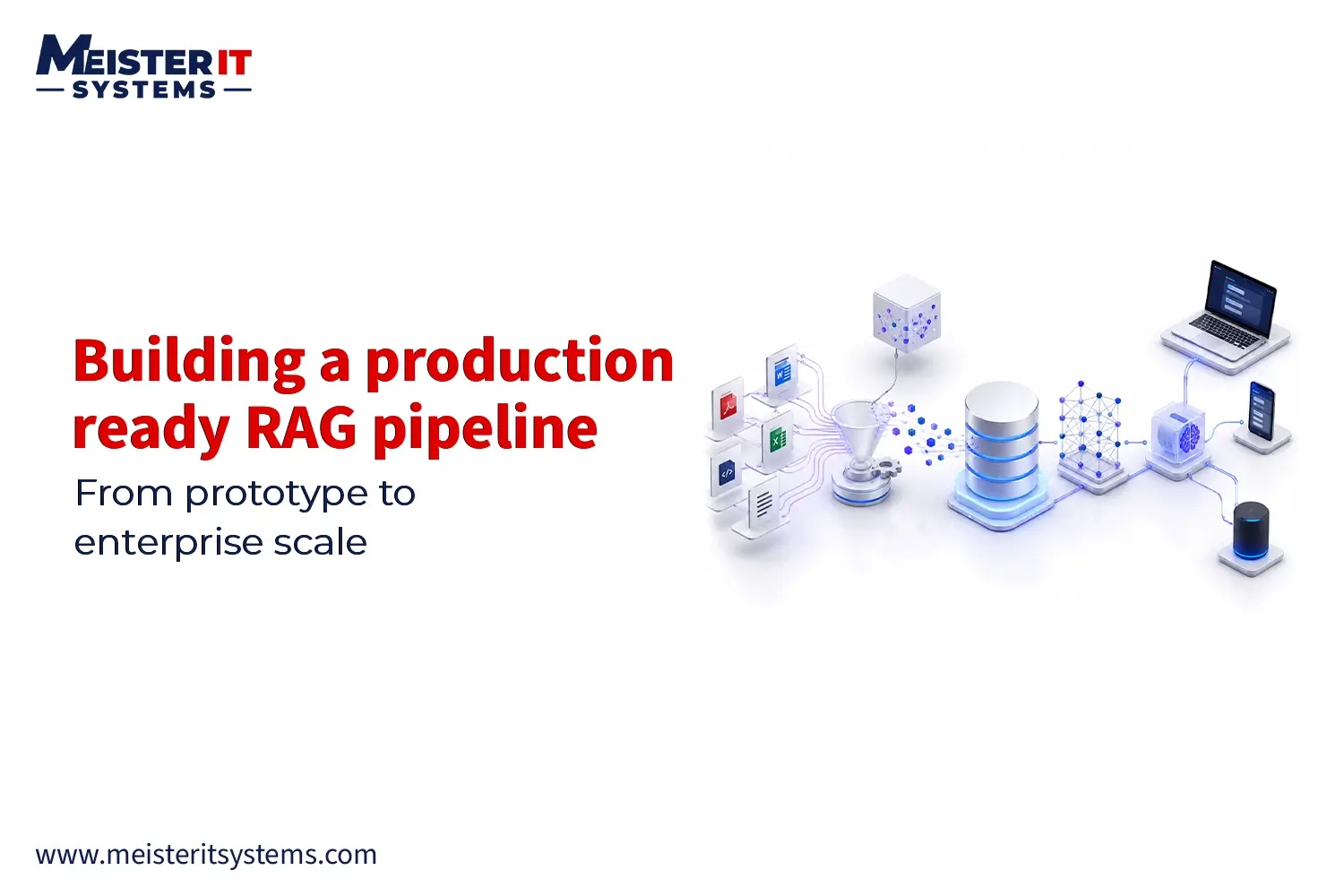
Core Enterprise RAG Architecture and Scalable Storage Layers
A mature, enterprise-grade architecture separates concerns into specialized layers. This ensures you can scale your data footprint without crashing your retrieval speeds or blowing past your cloud budget.
1. Ingestion Pipelines and Content Normalization
Enterprise data lives in disparate, fragmented silos: SharePoint repositories, Salesforce records, internal Wikis, and legacy databases. A production-ready RAG pipeline must continuously pull from these data sources, normalize unformatted text, strip out duplicate entries, and execute deterministic chunking strategies.
2. Multi-Tiered Knowledge Storage
For high performance, your storage strategy requires clear separation:
- Vector Databases (e.g., Pinecone, Milvus, pgvector): Highly optimized indexes that store vector embeddings for semantic similarity math.
- Metadata Storage: Relational or key-value stores that log crucial context details like document ownership, creation dates, department tags, and security clearings.
- Object Storage (e.g., AWS S3): Secure storage hosting the original raw files, allowing the system to surface accurate citations and source text.
The Hybrid Retrieval Layer: Why Standard Vector Search Fails
One of the biggest misconceptions in enterprise AI is that success depends entirely on picking the newest or most expensive large language model. In reality, retrieval quality has a far greater impact on accuracy than the choice of LLM. If your retrieval engine feeds outdated, irrelevant, or incomplete context to the LLM, the output will be fundamentally flawed, no matter how intelligent the model is.
Many organizations discover that retrieval quality drops significantly once document collections exceed several million chunks without strong metadata filtering and reranking layers. Standard semantic vector search looks for conceptual similarity, but corporate employees routinely search using precise product codes, legal acronyms, internal terminology, or exact document titles. Pure vector space math frequently misses these exact string matches.
Implementing Hybrid Retrieval and Reranking
To build a truly reliable engine, you must implement a Hybrid Retrieval workflow that merges semantic intelligence with traditional keyword precision.
The pipeline operates in three distinct phases:
- Parallel Search: The incoming user query is sent simultaneously to a traditional keyword search engine (using BM25 algorithmic scoring) and a semantic vector index.
- Metadata Filtering: The system applies strict structural rules immediately to discard any chunks the user does not have explicit access to based on department or region.
- Cross-Encoder Reranking: The top 50 to 100 combined results are passed into a secondary, highly specialized reranking model. This model scores the actual textual relevance of the chunk relative to the query, bubbling the absolute best 3 to 5 chunks to the top before they hit the LLM.
Keeping Enterprise Knowledge Fresh via Real-Time Incremental Indexing
Data drift and stale knowledge are major deployment realities. Corporate policies evolve, product inventories change hourly, and client files update continuously. If your RAG pipeline relies on static data, your application will confidently hallucinate outdated facts.
Rebuilding an entire vector index from scratch daily is incredibly expensive and slow at an enterprise scale. Instead, high-performing architectures leverage Change Data Capture (CDC) combined with an incremental indexing loop.
This automated pipeline detects localized alterations at the source database layer, pushing only modified or brand-new text blocks through the chunking and embedding microservices. Older vector segments are pruned instantly, keeping cloud costs predictable while maintaining an incredibly fresh knowledge baseline.
Common Failure Points in Production RAG Deployments
When scaling up a production RAG pipeline, several major engineering challenges regularly stall enterprise deployments:
- Poor Chunking Strategies: Using arbitrary token cutoffs often cuts sentences in half, causing the system to lose context. Successful architectures use semantic chunking based on document structures like headers and lists.
- Missing or Weak Metadata: Failing to enrich text chunks with clear tags makes targeted filtering impossible, leading to highly bloated retrieval results.
- Stale Embeddings: Updating your underlying embedding model without completely re-indexing your older vector data will break your entire mathematical similarity space.
- Permission Leakage: Allowing the retrieval engine to pull context from secure folders that the querying user should not see is a massive corporate vulnerability.
- Context Overload: Stuffing too many retrieved documents into the LLM prompt dilutes critical information and drastically increases latency.
Security, Governance, and RBAC Permission Synchronization
In the era of strict global AI governance regulations, corporate data privacy cannot be an afterthought. Permission synchronization failures are one of the most common causes of enterprise AI deployment delays.
Your RAG system must perfectly respect your existing IAM (Identity and Access Management) infrastructure. If an employee does not have permission to read a specific salary sheet within SharePoint or a sensitive contract inside your CRM, the RAG platform must dynamically filter out those document vectors during the retrieval phase.
This access control must happen before the data ever reaches the language model layer, preventing severe internal data leaks. Furthermore, a strict audit logging system must log every single query, retrieved context chunk, and LLM output to guarantee compliance with SOC 2, HIPAA, and GDPR rules.
Expanding the AI Frontier: Multimodal RAG and Agentic Workflows
As enterprise software matures, text-only data search is no longer sufficient. Production systems are rapidly evolving into complex, multi-functional applications.
1. Multimodal RAG
Modern corporate documentation is filled with charts, architecture diagrams, product images, and embedded video files. Multimodal RAG addresses this by using specialized vision-language models to embed both imagery and text into a unified vector space, allowing an automated platform to scan technical diagrams or financial slide decks just as easily as standard text files.
2. Enterprise RAG vs. AI Agents
The industry is shifting from purely passive informational search toward proactive, autonomous systems.
- Standard RAG Platforms: Primarily focus on information retrieval. They take an incoming query, fetch relevant text chunks, and present a well-grounded summary answer to the user.
- Agentic RAG Workflows: Leverage autonomous AI agents that use RAG as a foundational tool. An agent can analyze a user’s request, break it down into multiple separate sub-queries, independently decide which databases to query, evaluate the quality of the retrieved information, and execute subsequent business actions.
Real-World Industry Use Cases for Scalable AI
Here are a few practical examples of how organizations deploy enterprise-grade RAG systems across different sectors:
1. Healthcare Systems
Large medical providers use production-grade RAG systems to query complex clinical workflows, pharmaceutical guidelines, and operational policies. The system maps unstructured medical text into precise answers while complying fully with HIPAA privacy controls by filtering data access based on practitioner credentials.
2. E-commerce and Retail
Global retail platforms combine product catalogs, inventory supply chain systems, and legacy customer service logs into a unified AI search engine. Using hybrid retrieval, customer support teams can query real-time stock levels, tracking IDs, and custom returns policies simultaneously without leaving their internal dashboard.
System Optimization: Latency, Retrieval Metrics, and Cost Control
You cannot optimize what you do not actively monitor. In large deployments, token costs often become less expensive than retrieval infrastructure bottlenecks caused by poor indexing strategies. Maintaining a fast, cost-effective platform requires measuring operational metrics continuously across three domains:
1. Retrieval Performance
- Recall@K: The percentage of times the system successfully captures the required target document within the top K retrieved results.
- Precision@K: Out of all the context pieces retrieved, how many were genuinely relevant to solving the user’s query?
- Mean Reciprocal Rank (MRR): Measures exactly how high up in the list the most relevant chunk appeared. Higher placement reduces unnecessary context clutter.
2. Operational Latency
- Time to First Token (TTFT): Tracking the speed of your infrastructure setup, ensuring users do not experience noticeable delays.
- Embedding Caching Rates: Reusing older vector generation results for identical queries to preserve processing power and keep latency under two seconds.
3. Cost Control Tactics
Advanced architectures protect their budgets by implementing smart Model Routing. Simple, repetitive factual lookup tasks are automatically routed to smaller, highly efficient models. Expensive, frontier LLMs are reserved exclusively for complex logic, multi-document synthesis, and nuanced text reasoning.
Build Your Enterprise RAG Architecture with MeisterIT Systems
Enterprise AI projects fail when retrieval quality, data governance, and infrastructure scalability are treated as afterthoughts. Successful RAG systems require a resilient architecture, secure enterprise integrations, and continuous optimization across the entire data engineering pipeline.
At MeisterIT Systems, we help organizations design, develop, and optimize enterprise-grade RAG platforms that scale securely across millions of records and thousands of active users. Whether you are building internal corporate knowledge engines, customer support automation systems, or custom DevOps automation platforms, our team helps you transition smoothly from a basic prototype into a robust production ecosystem.
Contact us today to build a production-ready AI architecture tailored to your business goals.
Frequently Asked Questions
Q1: What is a production-ready RAG pipeline?
A production-ready RAG pipeline is a highly secure, automated AI architecture designed to connect enterprise data sources directly to language models, using hybrid search, metadata filters, and access governance to deliver highly accurate answers at scale.
Q2: How does hybrid retrieval improve RAG accuracy?
Hybrid retrieval combines semantic vector search with traditional keyword search (BM25). This ensures the AI understands the conceptual meaning behind a prompt while still catching exact serial numbers, product codes, or acronyms.
Q3: What are the biggest challenges in enterprise RAG?
The most common friction points include unoptimized document chunking, stale data indexes, high infrastructure costs, and complex permissions synchronization across internal data repositories.
Q4: How do enterprises secure RAG systems?
Security is achieved by implementing role-based access control (RBAC) at the metadata level, ensuring the system filters out restricted files before sending context to the LLM, alongside using encrypted storage and detailed audit logging.
Q5: What vector databases are best for enterprise AI?
Popular enterprise-grade options include Pinecone for fully managed scaling, Milvus and Weaviate for large-scale open-source vector search, and pgvector for organizations looking to extend their existing PostgreSQL database infrastructure.
Q6: How is enterprise RAG different from AI chatbots?
Traditional chatbots rely purely on the static information they memorized during their initial training phase. Enterprise RAG systems dynamically fetch real-time data from external corporate systems right when a query is made, preventing outdated answers.
Q7: What metrics should teams track in RAG systems?
Engineering teams must track retrieval quality metrics like Recall@K, Precision@K, and Mean Reciprocal Rank (MRR), alongside systems performance metrics like query latency, API error rates, and infrastructure compute utilization.
Q8: How do companies keep RAG data updated in real time?
Enterprises implement Change Data Capture (CDC) systems that constantly scan source documents for modifications. When a file changes, the system instantly executes incremental indexing to update only that specific text chunk in the vector database.