
Key Takeaways
- AI agent development helps businesses automate complex, multi-step workflows and improve operational efficiency.
- AI agents can understand context, access business data, use tools, and perform controlled actions.
- Secure AI agents require role-based permissions, human approval gates, testing, monitoring, and audit trails.
- MeisterIT Systems develops custom, scalable AI agents that integrate with existing business software and processes.
Introduction
Custom AI agent development is transforming how modern businesses automate operations and serve customers. Intelligent AI agents can understand requests, retrieve business data, connect with software tools, make controlled decisions, and complete multi-step workflows. This helps organisations improve operational efficiency, customer experience, productivity, and decision-making while reducing repetitive manual tasks.
This AI agent development guide covers how AI agents work, common types, business use cases, development processes, technology stacks, software integrations, security challenges, costs, and benefits. It also explains how to choose an AI agent development company and build secure, scalable AI agent solutions that deliver measurable business value.
What is AI Agent Development?
AI agent development is the process of designing and building intelligent software systems that can independently perform tasks, make decisions, and interact with digital tools or business applications.
Unlike traditional automation, which follows fixed rules, an AI agent can interpret context, reason through a problem, select the right action, and adapt its response based on new information.
For example, a traditional support workflow may send a standard response when a customer selects a particular option. An AI customer support agent can understand the customer’s actual question, search a knowledge base, review account information, provide a relevant answer, and escalate the issue when human assistance is required.
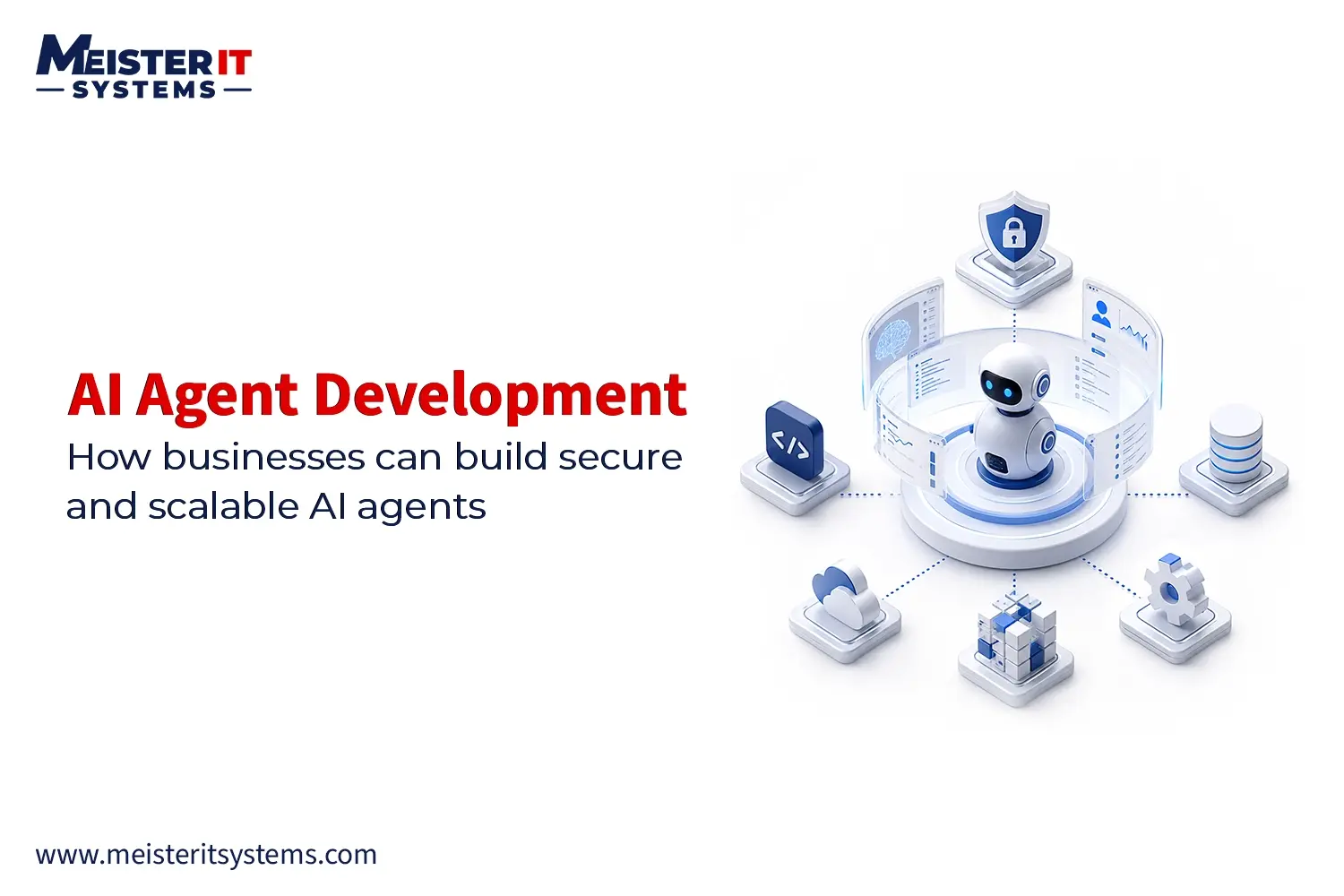
An AI agent generally combines:
- A large language model or machine learning model
- Business data and contextual information
- APIs and third-party integrations
- Memory and knowledge retrieval
- Decision-making logic
- Security permissions and approval controls
- Monitoring and feedback mechanisms
These components allow the agent to work within a controlled business environment while completing useful tasks.
How Do AI Agents Work?
AI agents operate through a continuous cycle of understanding, reasoning, acting, and learning.
First, the agent receives a goal or request. This could be a customer question, a sales task, a system alert, or an internal business query.
Next, it analyses the available context. The agent may retrieve information from company documents, customer records, databases, previous conversations, or connected applications.
The AI agent then determines which action is required. Depending on its permissions, it might generate a response, update a record, call an API, prepare a report, schedule a meeting, or request human approval.
Finally, the agent records the outcome and uses feedback or updated information to improve future interactions.
A typical AI agent workflow looks like this:
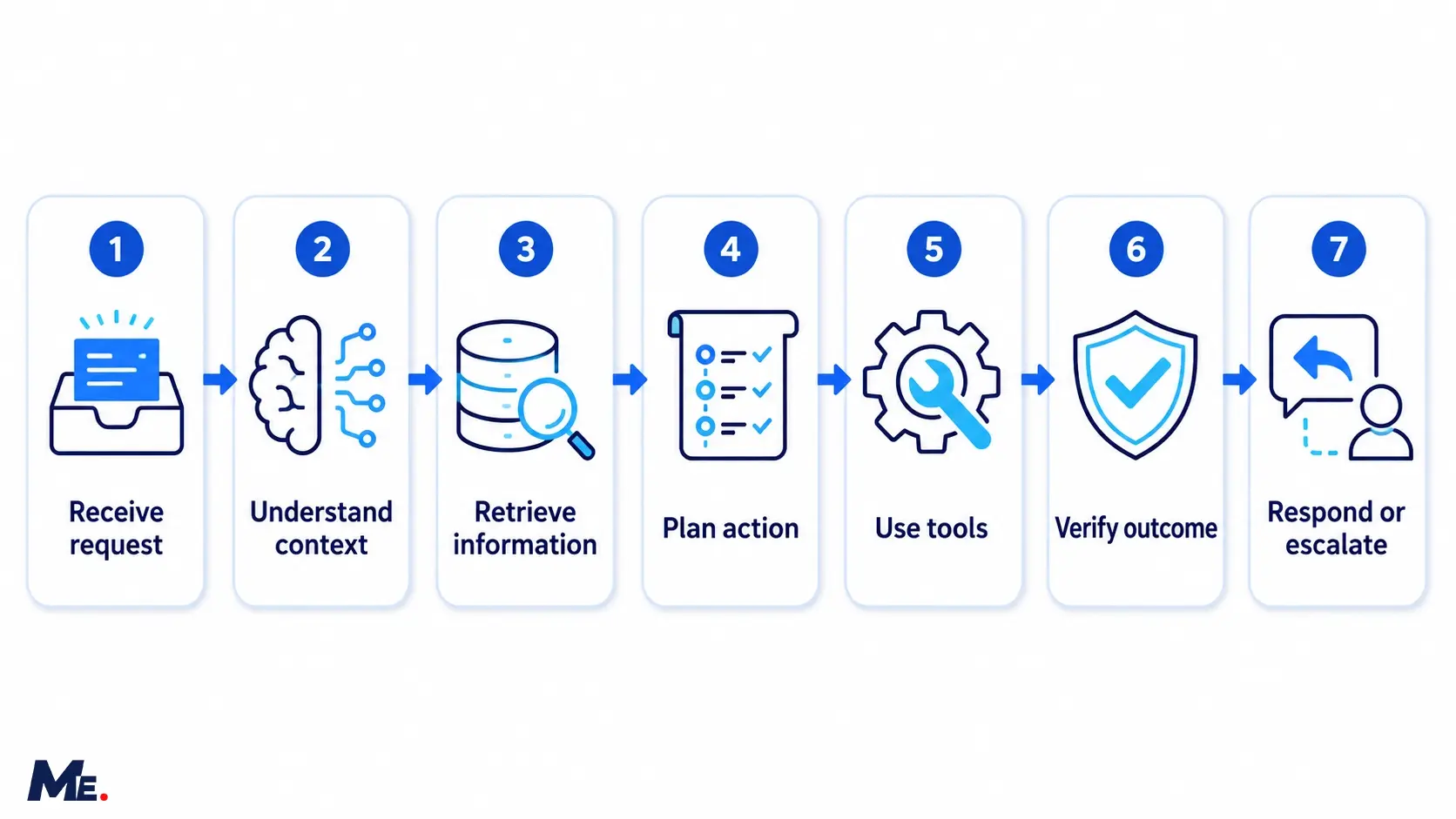
This ability to perform multi-step tasks makes agentic AI particularly valuable for complex business processes.
AI Agents vs Traditional Chatbots
Below is a quick comparison of AI agents and traditional chatbots:
| Feature | Traditional Chatbots | AI Agents |
|---|---|---|
| Primary purpose | Answer questions and guide users through predefined conversations | Complete tasks and achieve specific business goals |
| Decision-making | Follows fixed rules, scripts, or conversation flows | Analyses context and selects appropriate actions |
| Task complexity | Handles simple and repetitive queries | Manages complex, multi-step business processes |
| Tool usage | Usually provides text-based responses | Uses APIs, databases, CRMs, and other business tools |
| Autonomy | Requires user input at each stage | Can perform approved actions independently |
| Personalisation | Offers basic responses based on predefined conditions | Delivers personalised responses using real-time information |
| Learning ability | Provides limited adaptation without manual updates | Can improve through feedback, monitoring, and updated data |
| Human involvement | Transfers complex queries to a human agent | Requests human approval before sensitive or high-impact actions |
Key Business Use Cases for AI Agents
AI agent development can support multiple departments and industries. The right use case depends on business goals, available data, existing software, and operational challenges.
1. Customer Support
AI customer service agents can answer common questions, search knowledge bases, classify support tickets, summarise conversations, recommend solutions, and route complex cases to the appropriate team.
This can reduce response times while allowing human agents to focus on sensitive or complicated issues.
2. Sales and Lead Qualification
AI sales agents can analyse incoming leads, collect relevant details, personalise follow-up messages, update CRM records, recommend next steps, and schedule meetings.
They can also help sales teams identify high-intent prospects without manually reviewing every enquiry.
3. Marketing Operations
Marketing agents can support campaign research, content personalisation, audience analysis, performance reporting, and customer segmentation.
When connected to approved data sources, an agent can prepare campaign insights while keeping final strategic decisions with the marketing team.
4. IT Operations h3
AI agents can monitor applications, analyse error logs, identify unusual activity, recommend configuration changes, and create incident reports.
For security and reliability, production changes should require appropriate permissions and human approval.
5. Finance and Administration
Businesses can use AI agents to process invoices, categorise expenses, extract information from documents, prepare financial summaries, and identify missing data.
Financial agents should always operate within strict access controls and compliance requirements.
6. Human Resources
AI agents can answer employee questions, assist with onboarding, organise internal documents, screen information based on approved criteria, and automate repetitive administrative work.
Human review remains essential for hiring, disciplinary, compensation, and other sensitive decisions.
Types of AI Agents
Businesses can build different types of AI agents depending on the complexity of the required task.
1. Simple Reflex Agents
These agents respond to specific inputs using predefined rules. They are suitable for predictable and repetitive tasks but have limited decision-making capabilities.
2. Goal-Based Agents
Goal-based agents evaluate possible actions and select the option most likely to achieve a defined objective. They are useful for workflows involving several steps or conditions.
3. Learning Agents
Learning agents improve their performance using feedback and historical interactions. They are often used in recommendation systems, predictive analytics, and adaptive customer experiences.
4. Multi-Agent Systems
A multi-agent system contains several specialised AI agents that collaborate on a larger process. For example, one agent may collect information, another may analyse it, and a third may prepare a final report.
Multi-agent AI development can improve specialisation, but it also introduces additional complexity in coordination, security, testing, and monitoring.
AI Agent Development Process
Successful AI agent development begins with a clearly defined business problem. Building an agent without measurable goals can create an expensive system that delivers little operational value.
Step 1: Identify the Business Use Case
Start by selecting a process that is repetitive, time-consuming, data-driven, and suitable for partial automation.
Define the expected outcome, target users, current challenges, required data, and success metrics. Useful metrics may include response time, task completion rate, cost per interaction, error rate, and employee hours saved.
Step 2: Assess Data and System Requirements
The quality of an AI agent depends heavily on the information it can access. Businesses should review their documents, databases, APIs, CRM systems, cloud platforms, and internal applications.
Poorly organised or outdated data can lead to unreliable responses. Data preparation and access planning should therefore happen before development begins.
Step 3: Select the Technology Stack
The AI agent technology stack may include a large language model, an agent framework, a vector database, an API layer, cloud infrastructure, monitoring tools, and security controls.
The right selection depends on the use case, performance expectations, privacy requirements, integration complexity, and budget. Businesses should avoid choosing a model based only on popularity. Cost, response speed, accuracy, context length, and deployment options are equally important.
Step 4: Build the Knowledge and Retrieval System
Many business AI agents use retrieval-augmented generation, commonly known as RAG. A RAG system retrieves relevant information from trusted business sources before the AI model creates an answer.
This approach can improve accuracy, provide more business-specific responses, and reduce unsupported claims. It also allows organisations to update their knowledge base without retraining the entire model.
Step 5: Design Tools and Integrations
An agent becomes genuinely useful when it can interact with business systems.
Developers may connect the AI agent to:
- Customer relationship management software
- Enterprise resource planning systems
- Email and communication platforms
- Internal databases
- Payment or billing systems
- Cloud infrastructure
- Project management tools
- Custom business applications
Each integration should have clearly defined permissions. The agent should only access the information and actions required for its assigned role.
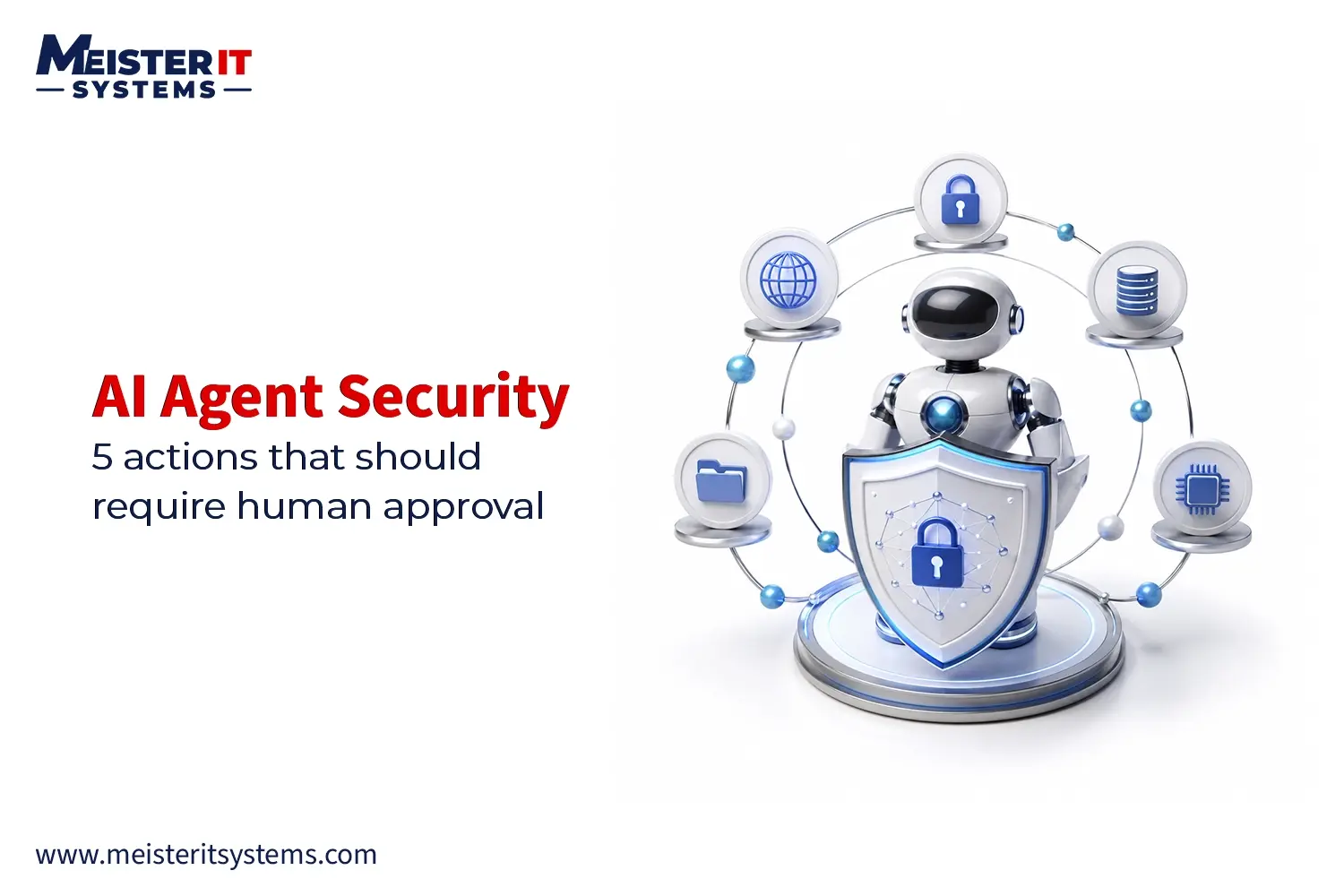
Step 6: Add Human Approval Controls
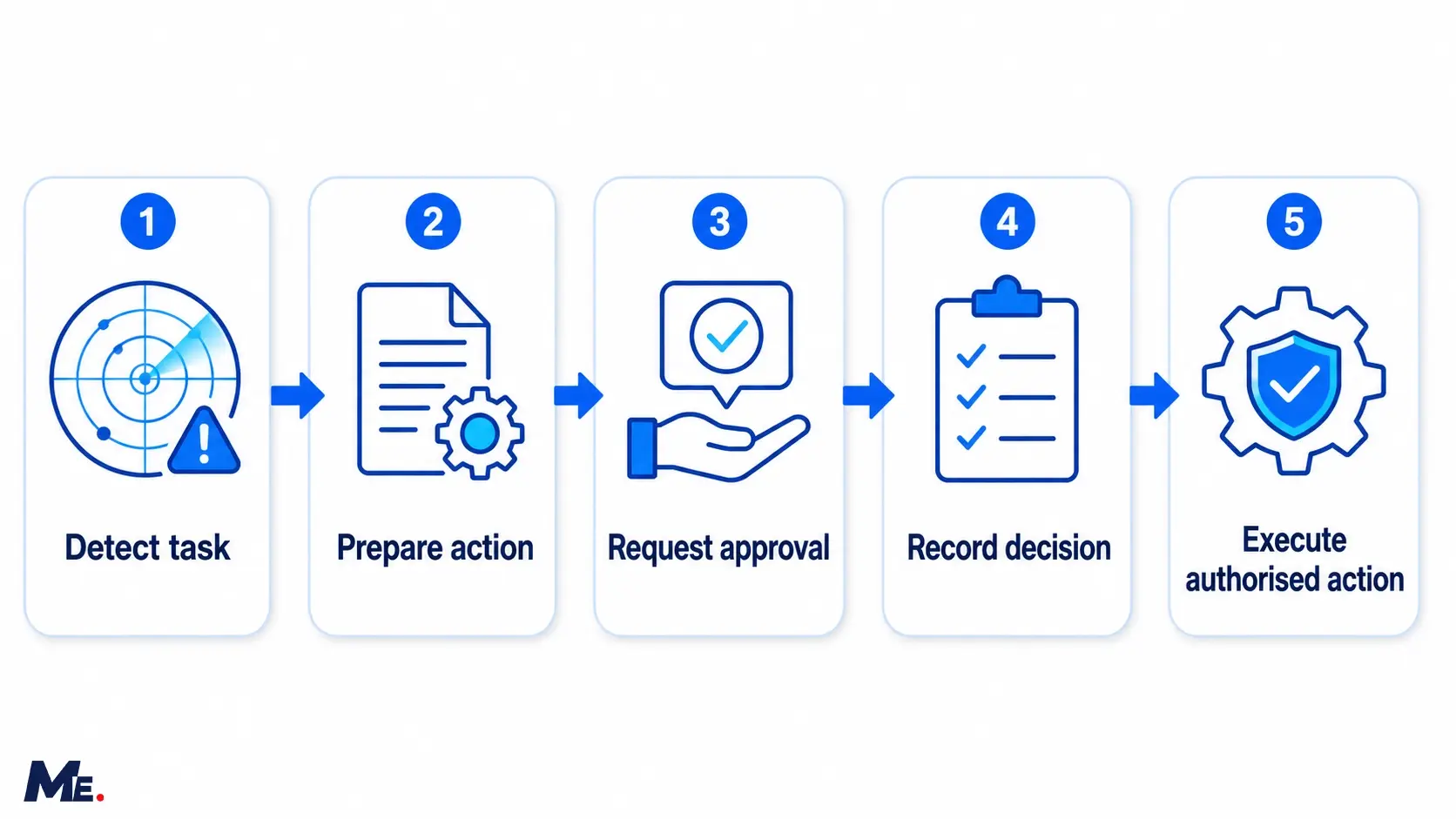
Businesses should determine which actions the agent can complete independently and which require human confirmation.
Low-risk actions, such as summarising a document, may happen automatically. High-impact actions, such as issuing refunds, modifying production systems, approving payments, or deleting records, should include human approval.
A controlled workflow may follow this process:
Step 7: Test the AI Agent
AI agent testing must cover more than technical functionality. Teams should test accuracy, reasoning, tool usage, permissions, edge cases, harmful inputs, incorrect data, system failures, and escalation behaviour.
The agent should also be tested with real business scenarios before a full-scale launch.
Step 8: Deploy, Monitor, and Improve
After deployment, businesses should continuously monitor performance, costs, errors, response quality, user feedback, and security events.
AI agents are not one-time development projects. Models, business data, integrations, and customer expectations change over time. Regular evaluation is necessary to maintain reliability.
Security Challenges in AI Agent Development
Security is one of the most important considerations when building AI agents for business.
An agent connected to internal systems may have access to customer information, company documents, financial records, or operational tools. Without proper safeguards, it could expose data or perform unintended actions.
Important AI agent security measures include:
- Role-based access control
- Data encryption
- Secure API authentication
- Input and output validation
- Audit trails
- Human approval gates
- Prompt injection protection
- Sensitive data masking
- Rate limits
- Continuous monitoring
Businesses should also maintain clear records of what the agent accessed, recommended, and executed. Auditability supports accountability, troubleshooting, and regulatory compliance.
Benefits of Custom AI Agent Development
Custom AI agent development allows businesses to create solutions around their existing systems, processes, and data.
The primary benefits include:
- Reduced manual workload
- Faster customer response times
- Improved operational consistency
- Better use of organisational knowledge
- Scalable service delivery
- Personalised customer experiences
- Faster data analysis and decision support
- Integration with existing business software
However, these benefits depend on thoughtful implementation. A poorly designed AI agent can create additional work, produce inconsistent results, or introduce security risks.
How Much Does AI Agent Development Cost?
The cost of developing an AI agent depends on its complexity, integrations, data requirements, security controls, and expected scale.
A basic internal knowledge assistant will generally cost less than a multi-agent platform connected to CRM, finance, customer service, and cloud systems.
The main cost factors include:
- Use-case complexity
- Number of integrations
- Data preparation requirements
- AI model and API usage
- User interface development
- Security and compliance
- Testing and evaluation
- Cloud infrastructure
- Ongoing monitoring and maintenance
The best approach is often to begin with a focused AI agent prototype, validate its business value, and then expand its capabilities gradually.
Choosing an AI Agent Development Company
The right AI development partner should understand both artificial intelligence and practical software engineering.
Before selecting an AI agent development company, evaluate its experience with custom software, cloud platforms, API integrations, data engineering, AI security, testing, and production deployment.
Ask whether the company can:
- Convert your business problem into a realistic AI use case
- Integrate the agent with your existing software
- Build secure approval and permission systems
- Test the agent against real business scenarios
- Monitor performance after deployment
- Scale the solution as usage increases
A reliable partner will not promise complete automation for every process. Instead, it will help you identify where AI can create measurable value without introducing unnecessary risk.
Conclusion
AI agent development can help businesses automate complex workflows, improve customer experiences, reduce operational pressure, and make better use of company data. The strongest AI agents are not simply intelligent. They are secure, measurable, integrated, and designed around a clear business objective.
Successful implementation requires the right combination of AI models, business data, software integrations, human oversight, security controls, and continuous monitoring.
MeisterIT Systems helps businesses design and develop custom AI agents that work with their existing software and operational processes. Whether you want to validate an AI agent idea, build a working prototype, integrate AI into an existing platform, or deploy a production-ready solution, our team can support the complete development journey.
Ready to explore how an AI agent could improve your business operations?
Contact our experts today to book a free consultation and turn your AI agent idea into a secure, scalable solution.
Frequently Asked Questions
1. What is AI agent development?
AI agent development is the process of building intelligent software that can understand requests, access data, make decisions, use digital tools, and complete tasks with limited human intervention.
2. How are AI agents different from traditional chatbots?
Traditional chatbots mainly answer questions using predefined rules. AI agents can understand context, retrieve information, connect with business systems, and perform multi-step actions.
3. How much does AI agent development cost?
AI agent development costs depend on the solution’s complexity, required integrations, data preparation, security controls, cloud infrastructure, and expected usage.
4. Are AI agents secure for business use?
AI agents can be secure when developed with role-based access, data encryption, approval gates, audit trails, secure API authentication, and continuous monitoring.
5. How long does it take to develop an AI agent?
A basic AI agent prototype may take a few weeks, while a production-ready solution with multiple integrations, advanced security, and custom workflows may require several months.